

Hemp fabric earns its reputation as a durable, breathable, lower-impact natural fiber, but the label “hemp” doesn’t guarantee every benefit. Cultivation is genuinely lighter on water and pesticides, the fiber resists odor and holds up through years of washing, and it breathes better than most synthetics in summer heat. The catch: processing method and blend content decide how much of that promise actually reaches your closet, and stiffer hand-feel plus a higher price tag are the price of admission.
TL;DR:
- Mechanical processing of hemp results in a more environmentally friendly fiber with better durability and natural structure, while chemical regeneration creates softer, viscose-like fabrics.
- Hemp’s high strength and porous structure outperform cotton and linen in durability, breathability, UV protection, and odor control, especially in outdoor and travel wear.
- Growing hemp requires significantly less water and pesticides than cotton and can sequester carbon dioxide, but environmental impacts depend heavily on processing methods and supply chain transparency.
- Hemp fabric is ideal for sensitive skin due to its antimicrobial properties, but chemical finishes can trigger reactions unless the garment is certified with OEKO-TEX or similar standards.
- Authentic hemp clothing must list fiber percentages explicitly, and brands should clarify whether the fabric is mechanically processed or chemically regenerated to ensure accurate sustainability claims.
Table of Contents
- What Is Hemp Fabric and How Is It Made?
- How Does Hemp Perform: Strength, Breathability, and UV Protection?
- Is Hemp Fabric Actually Eco-Friendly to Grow?
- Is Hemp Fabric Good for Your Skin?
- How Do You Wash and Care for Hemp Clothing?
- What Are the Drawbacks of Hemp Fabric?
- How Do You Choose Genuine Hemp Clothing?
- What Does Dan Flashes Know About Bamboo Hemp?
- Can Hemp Fabric Cause Skin Reactions or Sensitivities?
- Where Does Hemp Fabric Work Best in Clothing?
- How Can You Tell Real Hemp From a Mislabeled Blend?
- The Honest Read on Hemp
- Shop Dan Flashes’ Bamboo-Hemp Shirt Collection
- Sources
- FAQ
What Is Hemp Fabric and How Is It Made?
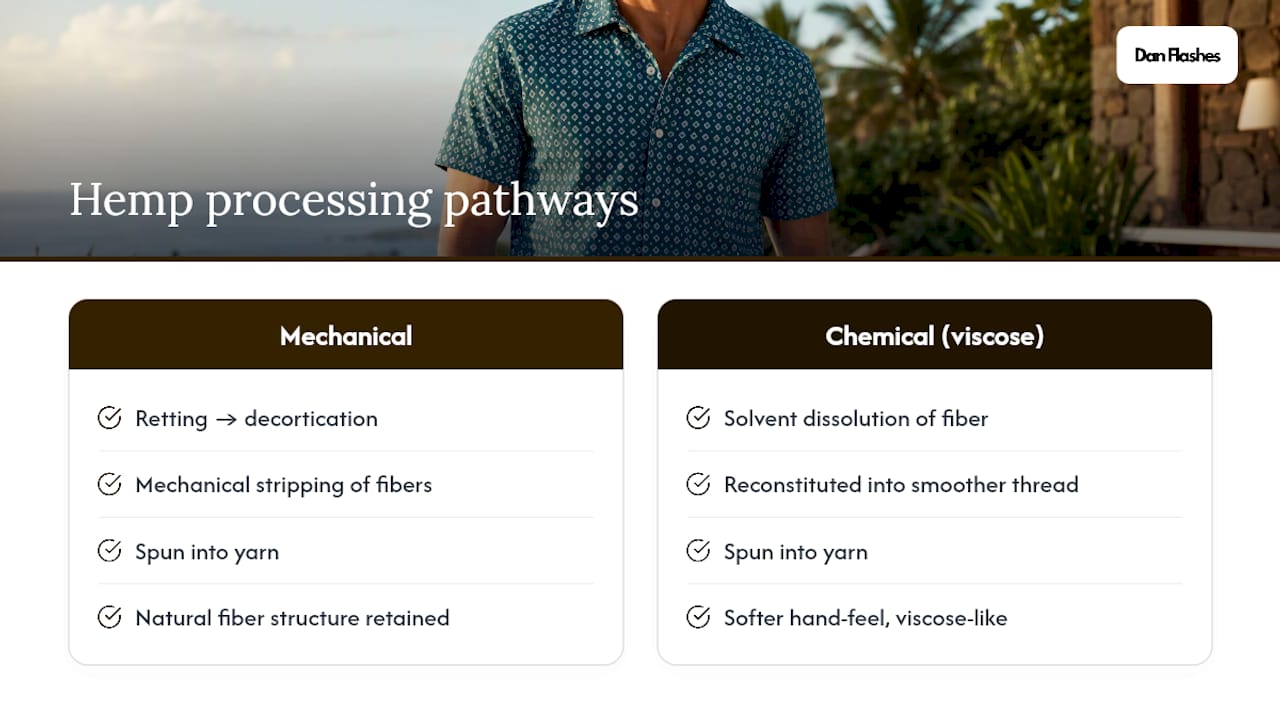
Hemp fabric starts as a bast fiber, meaning it comes from the stem of the Cannabis sativa plant rather than a seed pod like cotton. Growers cut the stalks, then separate the long fibers from the woody core through a process called retting (letting moisture and microbes loosen the fiber bundle) followed by decortication, which mechanically strips the usable fiber for spinning into yarn.
That mechanical route is the cleaner path. Chemically regenerated hemp, often labeled “hemp viscose,” runs the fiber through solvents to dissolve and reconstitute it into a smoother thread, which softens the hand-feel but pushes the fabric closer to conventional viscose in terms of chemical processing and environmental cost. Mechanically processed hemp keeps more of its natural fiber structure intact, and Good On You’s material guide treats it as a distinct, cleaner category apart from viscose-style hemp.
Blends complicate the picture further. Mixing hemp with polyester or conventional cotton changes the wear profile and, more importantly, the end-of-life impact, since even a modest synthetic percentage can block composting entirely.
How Does Hemp Perform: Strength, Breathability, and UV Protection?
Hemp’s biggest selling point isn’t a marketing term, it’s fiber physics. The plant produces one of the strongest natural fibers in commercial use, and consumer reporting puts hemp at up to eight times stronger than other fabrics used in daily wear, which explains why a well-made hemp shirt survives hundreds of wash cycles without falling apart at the seams.
That strength pairs with a porous fiber structure that moves air and moisture more efficiently than tightly woven synthetics. The same WebMD overview notes hemp’s natural thermoregulation: it helps you stay cooler when it’s hot and adds a layer of insulation when temperatures drop, which is unusual for a single fiber to manage well in both directions.
Here’s how hemp stacks up against cotton and linen on the metrics that actually matter when you’re picking a shirt:
- Durability: Hemp outlasts both cotton and linen under repeated washing, thanks to its long, strong fiber structure.
- Breathability: Hemp and linen perform similarly well in heat; cotton traps more moisture against skin.
- Feel out of the box: Linen softens faster than raw hemp; cotton starts soft but wears out sooner.
- UV resistance: Hemp’s dense weave blocks more ultraviolet exposure than lightweight cotton, making it a practical pick for beach and outdoor wear.
- Odor control: Hemp’s antimicrobial nature keeps it fresher between washes than cotton, an advantage for travel or multi-day wear.
If you’re weighing hemp against linen specifically for warm-weather shirts, the comparison on hemp versus linen breaks down which fiber wins for different summer use cases.
Is Hemp Fabric Actually Eco-Friendly to Grow?
Hemp cultivation uses a fraction of the water and pesticides that conventional cotton requires, and it can produce more usable fiber per hectare. That’s not a marketing claim, it’s backed by a peer-reviewed review that found hemp needs less water and fewer chemical inputs than cotton while yielding more fiber per unit of land.
Quick fact: Hemp is one of the few crops that can also sequester meaningful carbon dioxide during its growth cycle, and when the fiber ends up in long-lasting products, some of that stored carbon stays locked away rather than reentering the atmosphere. A 2024 review on hemp’s multi-utility potential points out this carbon benefit depends heavily on what happens after harvest, not just how the plant grows.
That caveat matters more than most sustainability marketing admits. Growing hemp responsibly is only half the equation:
- Retting and degumming (removing the plant’s natural gums to free the fiber) require energy and, depending on the method, chemical inputs.
- Long transport routes to specialized mills add fuel emissions that offset some of the field-level savings.
- A textile-focused life-cycle review found hemp’s environmental footprint sometimes matches or exceeds cotton’s once you account for outdated processing machinery.
So the environmental win is real, but it’s conditional. Look for brands that disclose mechanical processing and shorter, more transparent supply chains, since scarce specialized mills tend to inflate the transport and energy footprint of an otherwise low-impact crop.
Is Hemp Fabric Good for Your Skin?
Hemp’s antimicrobial and moisture-wicking properties make it a strong option for people with sensitive skin, since it naturally discourages the bacteria that cause odor and irritation in damp fabric. AZoM’s comparison of hemp and cotton points to this as one of hemp’s clearest advantages over less breathable synthetics.
Hypoallergenic doesn’t mean chemical-free, though. The fiber itself is low-irritation, but the dyes and finishing agents applied during manufacturing can still trigger sensitivity in some wearers. Checking for OEKO-TEX or similar certification helps screen out those residual chemicals.
Raw hemp starts out stiffer than cotton, but it softens meaningfully with washing and wear. Many people come to prefer that broken-in texture over a fabric that felt soft on day one and thin by year two. If you want softness sooner, a hemp-cotton or bamboo-hemp blend gets you there faster, though it trades some of hemp’s purity for comfort.
How Do You Wash and Care for Hemp Clothing?
Hemp rewards simple care. Wash in cold or warm water on a gentle cycle, skip the chlorine bleach, and tumble dry on low heat or line dry to protect the fiber’s structure over time. Harsh detergents and high heat are what actually shorten a hemp garment’s life, not normal wear.
The higher price tag on hemp clothing comes down to supply, not markup for its own sake. Fewer specialized mills process hemp fiber compared to the massive cotton infrastructure, and the fiber separation process is more labor-intensive. That cost evens out over time, since a hemp shirt that lasts eight years beats three cotton shirts that wear out in three.
- Wash in cold water on a gentle cycle.
- Skip bleach and fabric softener, both degrade the fiber.
- Line dry or use low heat.
- Store folded, not on hangers, to avoid shoulder stretching.
Pro Tip: Iron hemp while it’s still slightly damp. The fiber holds a crease better and you’ll need less heat to smooth out wrinkles than on fully dried fabric.
What Are the Drawbacks of Hemp Fabric?
Hemp isn’t the fabric for someone who wants immediate softness. Straight off the shelf, it drapes stiffer than cotton and wrinkles more visibly, and that break-in period can take several washes before it relaxes into something closer to broken-in denim.
Price and availability are the other real friction points. Limited mill infrastructure keeps hemp more expensive than mass-produced cotton, and that same infrastructure gap means transport adds more emissions per garment than a fiber grown and processed regionally.
Blends and viscose processing are where the sustainability story gets shakiest. A hemp-polyester blend loses most of its biodegradability, and hemp viscose runs through the same intensive chemical bath as conventional regenerated cellulosics, a very different environmental profile than mechanically processed hemp despite sharing the name.
Watch for labels that say “hemp blend” without a percentage, or “hemp-derived” phrasing that’s actually describing a viscose process. Genuine mechanically processed hemp usually lists a specific percentage and, ideally, names the processing method.
How Do You Choose Genuine Hemp Clothing?
Reading a label carefully saves you from paying hemp prices for a diluted blend. Check the fiber content tag for an exact percentage, not a vague “hemp blend” claim, and look for brands willing to say whether the fabric is mechanically processed or chemically regenerated as viscose.
- Confirm the percent composition (100% hemp behaves very differently from a 55/45 hemp-cotton blend).
- Look for supply chain transparency, ideally naming the mill or processing method.
- Check for OEKO-TEX or GOTS certification where the brand offers it, which screens for harmful residues in dyes and finishes.
- Decide upfront whether you want 100% hemp’s durability and lower environmental footprint, or a blend’s faster softness.
- Favor brands that offer repair or care guidance, since that usually signals they expect the garment to last.
| What to check | Why it matters | Red flag |
|---|---|---|
| Fiber percentage | Determines actual durability and biodegradability | “Hemp blend” with no number listed |
| Processing method | Mechanical hemp vs. viscose changes environmental impact | No mention of retting or processing at all |
| Certification | Screens dyes and finishes for skin safety | No certification and vague “eco-friendly” language |
| Care instructions | Long-term value depends on proper washing | No care label or generic “machine wash” only |
What Does Dan Flashes Know About Bamboo Hemp?
Dan Flashes works with bamboo hemp as one of its core sustainable fabric options, choosing it specifically because the blend softens the stiffness raw hemp is known for while keeping the breathability and durability that make hemp worth seeking out in the first place. That balance matters for a beach or travel shirt that needs to feel good against skin on day one, not just after a dozen washes.
Orders carry a 30-day money-back guarantee, which lowers the risk of trying a fiber that behaves differently than cotton. If you’re comparing regenerated fibers to mechanical processing, the breakdown on bamboo viscose versus cotton covers how that distinction plays out in real garments, which lines up directly with the buying checklist above.
Can Hemp Fabric Cause Skin Reactions or Sensitivities?
True allergic reactions to hemp fiber itself are rare, which is part of why dermatology-focused sources recommend it for sensitive skin in the first place. Most reported irritation traces back to something added during manufacturing rather than the fiber, azo dyes, formaldehyde-based wrinkle-resistant finishes, or residual processing chemicals left in the weave.
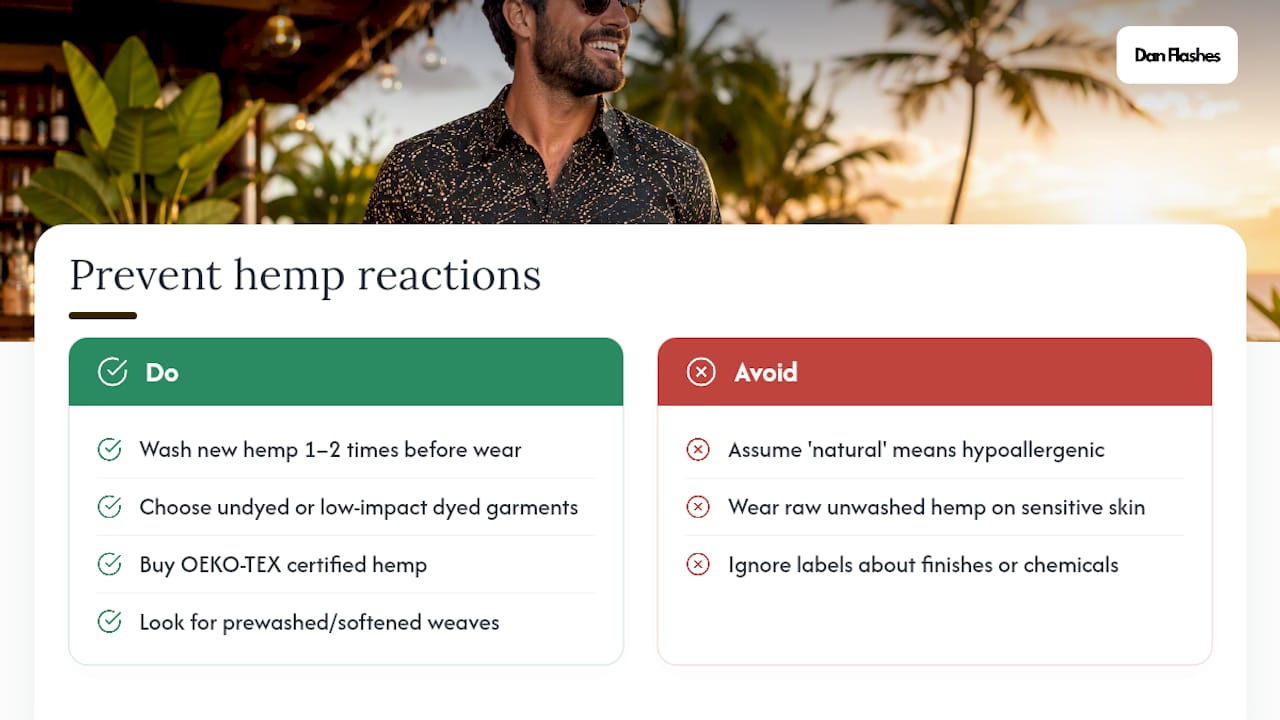
People with contact dermatitis or eczema sometimes react to the rougher texture of raw, unwashed hemp before it’s had a chance to soften, mistaking mechanical friction for an allergic response. Washing a new hemp garment once or twice before wearing it against skin removes surface residues and softens the weave enough to reduce that friction.
There’s also a distinction worth knowing if you have plant-based allergies: hemp fiber comes from the stalk, not the seed or flower, so it doesn’t carry the same allergenic proteins found in hemp seed products or, obviously, in cannabis flower itself. If you react to hemp seed oil in food or skincare, that doesn’t necessarily predict a reaction to hemp fabric.
The practical takeaway: if you have known sensitivities, look for undyed or low-impact-dyed hemp garments, and check for OEKO-TEX certification, which specifically tests for the chemical residues most likely to trigger a reaction, rather than assuming “natural fiber” automatically means “hypoallergenic.”
Where Does Hemp Fabric Work Best in Clothing?
Hemp shows up across a wider range of garment types than most people expect, largely because its strength lets it work in both heavyweight and lightweight weaves. Lighter hemp weaves, often blended with cotton or bamboo, make sense for warm-weather button-ups, beach shirts, and travel wear where breathability and UV resistance both matter.
Heavier hemp canvas shows up in workwear, denim alternatives, and outerwear, where the fiber’s tensile strength translates into garments that resist tearing and abrasion far longer than a cotton equivalent. Mid-weight hemp blends land in everyday shirts, the category where softness, structure, and durability all need to balance against each other.
Accessories benefit too. Hemp’s resistance to stretching and its natural antimicrobial properties make it a solid choice for caps and bags that see daily use and irregular washing schedules. If you’re deciding between fiber options for warm-weather shirts specifically, the comparison of cotton versus synthetic fabrics lays out where natural fibers pull ahead for comfort in heat, a comparison that extends naturally to hemp as well.
How Can You Tell Real Hemp From a Mislabeled Blend?
The fastest test happens before you buy: read the fiber content line on the tag, not the marketing copy on the hangtag. “Hemp-inspired,” “hemp-derived,” or “eco hemp blend” phrasing without a specific percentage is a signal the garment may contain very little actual hemp fiber.
Feel matters too, though it’s not foolproof. Genuine mechanically processed hemp has a slightly coarse, linen-like hand-feel when new, and it holds a crease more stubbornly than cotton. A fabric marketed as “hemp” that feels immediately silky and drapes like rayon is very likely hemp viscose, a legitimate material but a different sustainability and durability profile than mechanical hemp, and one Sustainable Jungle’s guide recommends treating as its own category rather than assuming it behaves like raw hemp.
Ask the brand directly if the label doesn’t answer your questions. A company confident in its sourcing will usually name the processing method and the percentage of hemp fiber without hesitation. Vague answers, or answers that pivot to “eco-friendly” language without specifics, are the clearest red flag that the “hemp” claim is doing more marketing work than fabric work.
The Honest Read on Hemp
Most hemp marketing skips the part where processing method matters more than the word “hemp” on a tag. That’s the gap the research actually supports: a mechanically processed hemp shirt and a hemp viscose shirt share a name and very little else, and treating them as interchangeable is where most sustainability claims fall apart under scrutiny.
The conventional advice tells you to buy hemp and stop thinking about it. The better approach is to prioritize the percentage and the process first, softness and price second. A 100% mechanically processed hemp shirt that feels a little stiff in month one will outlast and out-perform a soft-from-day-one blend that’s mostly cotton with a hemp label attached.
Where bamboo-hemp blends earn their place is in solving the one real complaint people have about raw hemp: the break-in period. That’s not a workaround, it’s a legitimate answer to a legitimate tradeoff, and it’s worth choosing on purpose rather than by accident.
- Dan Flashes
Shop Dan Flashes’ Bamboo-Hemp Shirt Collection
The bamboo-hemp lineup balances hemp’s durability and breathability without the stiff break-in period that turns some buyers off raw hemp entirely. The Essential Pattern Band Collar Shirt uses that bamboo-hemp blend for an everyday shirt that softens fast and holds its shape through repeated wear, whether that’s a work day or a flight.

For beach trips and travel, the vibrant patterns in the Hawaiian Pattern Shirt and the broader beach shirt collection cover the lightweight, breathable end of the lineup, where hemp’s natural UV resistance and odor control actually pay off outdoors. Orders come with a 30-day money-back guarantee, so trying a hemp blend for the first time doesn’t mean committing blind. Browse the current bamboo-hemp shirt to find the fit and pattern that matches how you’ll actually wear it.
Sources
- Hemp Fabric: Facts, Characteristics, Uses - WebMD
- Review: Hemp’s sustainability and utility (PMC/NCBI)
- Textile production chain and LCA considerations for hemp - MDPI review
- What is hemp fabric? - Sustainable Jungle
FAQ
What Are the Downsides of Hemp Fabric?
Hemp starts out stiffer than cotton or linen, costs more due to limited processing infrastructure, and loses its biodegradability when blended with synthetics like polyester.
Is Hemp Fabric Better Than Cotton?
Hemp generally outperforms cotton on durability, breathability, and water use during cultivation, though cotton feels softer right out of the package and remains cheaper and easier to find.
Is Hemp Fabric Good for Your Skin?
Yes. Hemp’s natural antimicrobial and moisture-wicking properties make it a strong option for sensitive skin, though checking for OEKO-TEX certification helps rule out irritation from dyes or finishing chemicals.
Does Hemp Fabric Shrink or Wrinkle Easily?
Hemp wrinkles more visibly than cotton when new, but shrinkage is minimal with cold-water washing and low-heat drying, the same care routine that protects its fiber strength over time.
Are Bamboo-Hemp Blends Actually More Sustainable?
Bamboo-hemp blends soften faster and feel more comfortable sooner than 100% hemp, though a garment’s biodegradability depends on the exact fiber percentages and how it’s processed, which is worth checking on the label before assuming a “greener” claim.


