

The slow fashion movement is a deliberate rejection of disposable clothing culture based on one core idea: buy less, choose better, and make things last. Oxfam frames it as an approach that prioritizes positive outcomes for both the planet and the people who make our clothes. If you take one thing from this article, let it be this: the single most effective action you can take today is to stop before your next purchase and ask whether you actually need it.
Three pillars hold the movement together:
- Quality over quantity: Fewer, better-made garments that last years, not seasons.
- Ethical labor: Wages and conditions that don’t depend on workers absorbing the cost of cheap prices.
- Transparency: Brands that can tell you where and how a garment was made, not just where it was packaged.
Good On You describes slow fashion as mindful, quality-focused consumption that emphasizes timeless design, longevity, and supply-chain transparency. That framing is useful because it centers the consumer’s role, not just the brand’s.
Key Takeaways
The slow fashion movement’s most important insight is this: the true cost of cheap clothing is paid by workers, ecosystems, and future generations, and buying less, repairing more, and choosing durable natural fibers is how individual consumers begin to shift that equation.
| Point | Details |
|---|---|
| Definition | Slow fashion prioritizes quality, ethical labor, and longevity over speed and low price. |
| Origins | Kate Fletcher coined the term around 2007, drawing on the Slow Food movement’s critique of industrial production. |
| Top consumer action | Audit your wardrobe, repair before replacing, and buy second-hand before buying new. |
| Materials matter | Natural fibers like cotton, linen, and bamboo-hemp outperform polyester on durability and environmental impact. |
| Greenwashing is real | “Sustainable” is an unregulated term in the U.S.; look for named factories and third-party certifications. |
Table of Contents
- What is the slow fashion movement and where did it come from?
- What are the core principles of slow fashion?
- How does fast fashion cause harm, and what does slow fashion fix?
- How can you practice slow fashion starting today?
- What do slow-fashion business models actually look like?
- What are the real criticisms of slow fashion?
- What does the research say about slow fashion’s benefits?
- Where is slow fashion headed, and how can you influence it?
- Where do you start?
- Why slow fashion matters to us at Danflashes
- Sources
What is the slow fashion movement and where did it come from?
The slow fashion movement didn’t appear out of nowhere. Its roots trace directly to the broader “slow movement” that began in Italy in the late 1980s, when Carlo Petrini launched Slow Food as a protest against a McDonald’s opening near the Spanish Steps in Rome. The logic was simple: speed and standardization in food production came at a cost to culture, health, and local economies. Fashion, it turned out, had the same problem.
The term “slow fashion” itself was coined by Kate Fletcher, a researcher at the Centre for Sustainable Fashion in London, around 2007. Fletcher drew an explicit parallel to Slow Food, arguing that fashion needed the same reckoning. Her early framing identified three guiding principles: a local approach to production, transparent sourcing, and what she called “sustainable sensorial products,” meaning garments designed to be experienced and valued rather than consumed and discarded. The Doruzova guide to slow fashion traces this lineage clearly and is worth reading for anyone who wants the full historical arc.
Before industrialization, most clothing was made locally, repaired routinely, and passed down. The 20th century changed that. Synthetic fibers, offshore manufacturing, and eventually the rise of fast fashion in the 1990s and 2000s compressed production cycles from months to weeks. Brands like Zara pioneered a model that could move a trend from runway to retail floor in under three weeks. The environmental and human costs of that speed became harder to ignore after events like the 2013 Rana Plaza factory collapse in Bangladesh, which killed more than 1,100 garment workers and forced a global conversation about who actually pays for cheap clothes.
What are the core principles of slow fashion?
Slow fashion is not a single certification or a brand category. It’s a set of values that can be applied at every point in a garment’s life. Good On You’s consumer guidance and the Wikipedia synthesis on slow fashion both converge on a consistent set of principles:
- Quality over quantity: A well-constructed shirt with reinforced seams and natural fibers will outlast three cheap ones. The practical test: check the seam allowance (wider is more durable) and whether buttons are sewn with a thread shank that allows movement.
- Longevity and repairability: Garments designed to be mended, not replaced. A brand committed to this principle will sell replacement buttons and offer repair guides.
- Transparency: Publishing the names and locations of factories, not just “ethically made” marketing copy. Genuine transparency means audit reports, not slogans.
- Ethical labor: Living wages, safe conditions, and no forced overtime. Third-party certifications like Fair Trade or SA8000 carry more weight than a brand’s self-declaration.
- Lower-impact materials: Organic cotton, linen, recycled fibers, and blends like bamboo-hemp reduce water use and chemical inputs compared to conventional cotton or virgin polyester. Danflashes’ guide to sustainable fabrics explains these trade-offs in practical terms.
- Local production and craft: Shorter supply chains reduce transport emissions and support regional economies. Bespoke tailors and small-batch makers typically fall here.
- Reduced consumption: Buying less is the most direct lever. A capsule wardrobe of 30-40 versatile pieces produces far less waste than a closet that turns over seasonally.
- Circularity: Repair, resale, upcycling, and responsible end-of-life disposal keep garments out of landfills longer.
On certifications: a label claiming “sustainable” or “ethical” with no third-party verification is marketing, not a guarantee. Look for specific certifications (GOTS for organic textiles, B Corp for company-wide accountability) and published supply-chain disclosures.
How does fast fashion cause harm, and what does slow fashion fix?
Fast fashion and slow fashion aren’t just different aesthetics. They represent opposite answers to the same question: who absorbs the true cost of a garment?
The apparel industry is a significant source of CO2e emissions, according to Statista’s industry dataset, making fashion’s climate footprint one of the clearest arguments for slowing production cycles.
Stat to know: The apparel sector ranks among the world’s most emissions-intensive industries, with Statista’s CO2e data showing it as a material contributor to global greenhouse gas output.
Worker conditions tell a parallel story. Fast fashion’s economics require labor costs to stay near zero, which concentrates production in countries with the weakest wage protections. The Rana Plaza collapse was the most visible consequence, but garment workers in Bangladesh, Cambodia, and Vietnam routinely earn wages well below a living standard, often in unsafe buildings.
Synthetic fibers compound the environmental damage. Polyester, the dominant fiber in fast fashion, sheds microplastics with every wash. A single synthetic garment can release hundreds of thousands of microplastic particles per wash cycle, particles that pass through wastewater treatment and accumulate in marine ecosystems. Natural fibers like cotton and linen biodegrade; polyester does not, persisting for centuries in soil and water.
Slow fashion addresses these harms by design. Longer production cycles allow for better construction. Higher prices, when they reflect real labor costs, mean workers are paid fairly. Natural and recycled fibers reduce both chemical inputs and microplastic pollution. Comparing cotton to synthetic options in shirting, for instance, shows how fiber choice alone changes a garment’s environmental profile across its full lifetime.
How can you practice slow fashion starting today?
The most effective slow-fashion consumers do five things: buy less, repair what they own, prioritize second-hand, invest selectively in quality, and choose lower-impact fibers when they do buy new. Here’s a practical sequence:
- Audit your wardrobe. Pull everything out. Identify what you actually wear, what needs repair, and what you haven’t touched in a year. Most people find they own far more than they use.
- Repair before replacing. A loose button, a split seam, a worn collar: all fixable in under 20 minutes with basic tools. A needle, thread, and a YouTube tutorial handle 80% of common repairs.
- Buy second-hand first. Thrift stores, resale platforms, and clothing swaps are the lowest-cost entry point into slow fashion. You’re extending a garment’s life without any new production.
- Invest selectively in quality. When you do buy new, calculate cost-per-use rather than sticker price. A $120 shirt worn 80 times costs $1.50 per wear; a $30 shirt worn 10 times costs $3.00. Full-cost thinking for shirts breaks this down further.
- Choose lower-impact fibers. Organic cotton, linen, and bamboo-hemp blends outperform virgin polyester on most environmental measures. Check the care label: fiber content is legally required on U.S. garments.
- Extend garment life actively. Wash in cold water, air dry when possible, store properly. Heat and friction are the main enemies of fabric longevity.
- Recycle or donate responsibly. When a garment truly reaches end of life, textile recycling programs (many municipalities and some retailers offer them) keep fibers out of landfill.
Pro Tip: To quickly judge construction quality in a store or at a thrift shop, pinch the fabric and hold it up to light. Tightly woven fabric with minimal light bleed indicates denser, more durable construction. Then check the seam allowance inside: anything under 1/2 inch is a sign the maker cut corners.
Pro Tip: *Fiber content labels can be misleading when a blend is listed as a single percentage. A shirt labeled “60% cotton, 40% polyester” will shed microplastics and won’t biodegrade cleanly.
Action tiers by budget:
- Low-cost: Repair, swap, thrift. Zero new production required.
- Mid-cost: Tailoring alterations, selecting durable natural-fiber basics.
- Higher-cost: Made-to-order pieces, local artisans, small-batch makers with published supply chains.
What do slow-fashion business models actually look like?
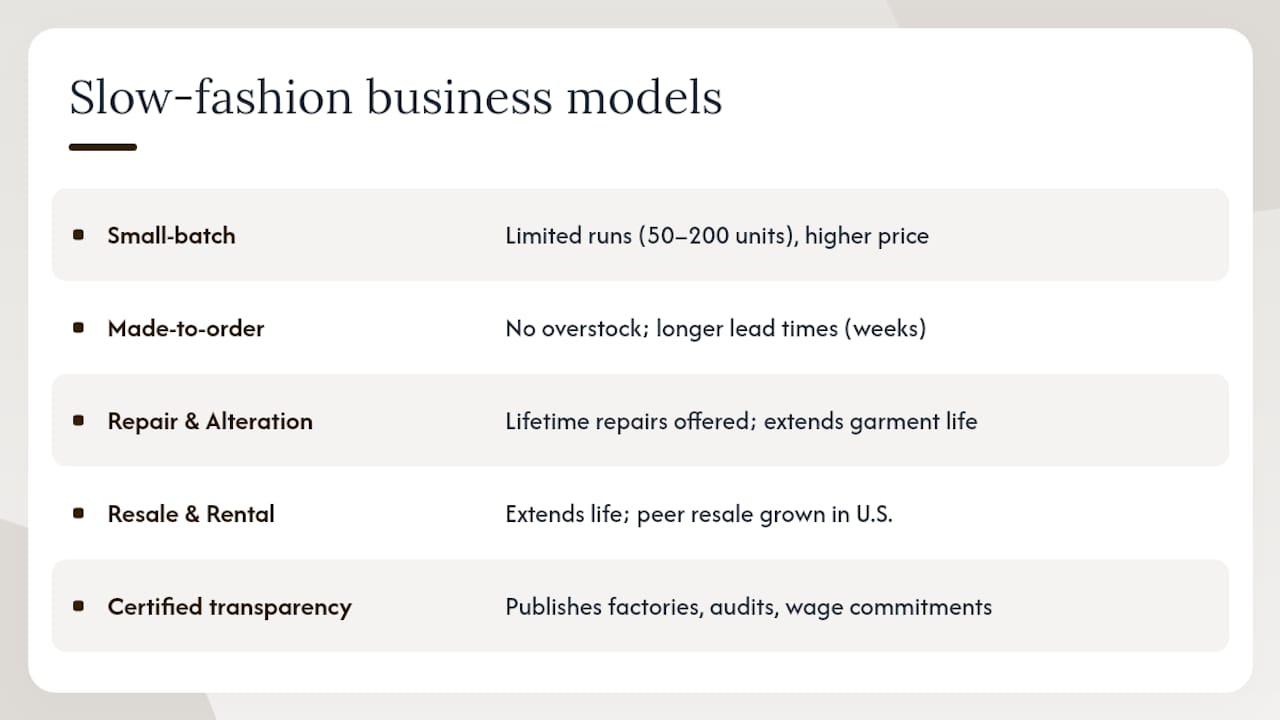
Slow fashion isn’t one business model. Several distinct approaches exist, each with different trade-offs for consumers.
Small-batch production means a maker produces a limited run of each design, often seasonally. Unsold inventory is minimal because production matches anticipated demand. Small-batch coastal shirting makers, for example, release collections of 50-200 units per design rather than thousands. The trade-off: higher prices and limited restocks.
Made-to-order goes further. Nothing is produced until a customer places an order, eliminating overstock entirely. Bespoke tailors and some direct-to-consumer brands operate this way. Lead times are longer (weeks rather than days), but waste is close to zero. Seasonal collections from design-focused labels, like those carried by Edito Boutique, often follow a slower, quality-driven release rhythm that aligns with this approach.
Repair and alteration services are underused but growing. Some brands now offer lifetime repair programs; independent tailors and cobblers have always offered this. For consumers, a good local tailor is one of the most practical slow-fashion investments available.
Resale and rental platforms extend garment life without new production. Peer-to-peer resale has grown substantially in the U.S. over the past five years, with platforms covering everything from everyday basics to designer pieces.
Certified supply-chain transparency is what separates a genuine slow-fashion brand from a marketing claim. Look for brands that publish factory names and locations, third-party audit results, and living-wage commitments. A brand that says “we care about workers” but won’t name its factories is telling you something. How eco-friendly Hawaiian shirt brands operate offers a useful framework for evaluating these claims in the shirting category specifically.
What are the real criticisms of slow fashion?
Slow fashion has genuine weaknesses, and ignoring them doesn’t help anyone make better decisions.
- Higher upfront cost. A well-made garment from a transparent brand costs more than a fast-fashion equivalent. For consumers on tight budgets, that’s not a philosophical choice; it’s a financial constraint.
- Accessibility gaps. Thrift stores in lower-income neighborhoods often carry lower-quality donations than those in wealthier areas, a documented pattern that limits second-hand access for the people who could benefit most.
- Greenwashing. “Sustainable,” “eco-friendly,” and “conscious collection” are unregulated marketing terms in the U.S. Any brand can use them. Without third-party verification, they mean nothing.
- Scalability questions. Small-batch and made-to-order models work for niche markets. Scaling them to serve hundreds of millions of consumers globally without reintroducing the pressures that created fast fashion in the first place is an unsolved problem.
- Supply-chain complexity. Even well-intentioned brands struggle to verify labor conditions five or six tiers deep in a global supply chain. Certifications help but don’t guarantee perfect compliance.
The equity concern deserves direct acknowledgment. Slow fashion, as currently practiced, skews toward consumers with disposable income. The honest answer is that second-hand buying, clothing swaps, and repair skills are the most accessible entry points, and community-level initiatives (repair cafés, clothing libraries, neighborhood swap events) can extend slow-fashion practices to people for whom buying a $200 shirt is not realistic. Policy interventions, like extended producer responsibility (EPR) laws that make brands pay for end-of-life textile disposal, can shift costs away from individual consumers and toward the industry.
What does the research say about slow fashion’s benefits?
The evidence base for slow fashion spans environmental data, labor economics, and consumer psychology.
On climate: Statista’s apparel-industry CO2e dataset confirms the sector’s material contribution to global emissions, providing the quantitative foundation for arguments about reducing production volume and extending garment lifetimes.
On well-being: a peer-reviewed study published in Sustainability (MDPI) found that slow-fashion practices tied to customized or bespoke processes positively predict well-being markers including engagement, meaning, and achievement. The MDPI study reports associations rather than proving causation, but the signal is consistent: people who engage deliberately with their clothing, rather than treating it as disposable, report higher psychological engagement with the objects they own.
On consumer behavior: NGO research from Oxfam and consumer platforms like Good On You consistently identify the same high-impact actions: buy less, buy better, repair, and buy second-hand. These recommendations appear across independent sources, which strengthens their credibility.
| Source | Main finding | Implication for consumers |
|---|---|---|
| Statista apparel CO2e data | Apparel is a material contributor to global greenhouse gas emissions | Reducing purchase volume and extending garment life lowers personal footprint |
| MDPI Sustainability study | Bespoke/slow practices positively predict engagement, meaning, and achievement | Deliberate clothing choices may improve psychological well-being |
| Oxfam slow fashion explainer | Slow fashion prioritizes positive outcomes for planet and garment workers | Supporting transparent brands has direct labor-rights implications |
| Good On You consumer guidance | Timeless design, longevity, and transparency define slow fashion for consumers | Practical steps: repair, second-hand, quality-first buying |
Where is slow fashion headed, and how can you influence it?
Policy is catching up to consumer demand, slowly. The European Union has moved furthest, with extended producer responsibility rules requiring textile brands to fund end-of-life collection and recycling. The U.S. has lagged, but several states, including California and New York, have introduced or passed legislation targeting fashion’s environmental footprint, including microplastic disclosure requirements and EPR frameworks for textiles.
Digital transparency tools are changing what consumers can demand. QR codes linked to supply-chain data, blockchain-based provenance tracking, and third-party rating platforms make it harder for brands to hide behind vague claims. Resale has grown into a significant market segment, with peer-to-peer platforms now accounting for a meaningful share of U.S. apparel transactions.
The levers consumers hold are more powerful than they’re often given credit for:
- Vote with purchases. Brands track sell-through data obsessively. Consistent demand for transparent, durable goods sends a signal that moves faster than any petition.
- Demand transparency. Email brands asking for factory names and audit results. The ones with nothing to hide will answer.
- Support repair infrastructure. Use local tailors, cobblers, and repair cafés. Their survival depends on customer volume.
- Engage with policy. EPR legislation, living-wage import standards, and microplastic regulations all have public comment periods and elected representatives who respond to constituent pressure.
- Join community initiatives. Clothing swaps, repair workshops, and local clothing libraries build the social infrastructure that makes slow fashion accessible beyond individual purchasing decisions.
The Ethos explainer on slow fashion frames this well: slow fashion is as much a cultural shift as a consumer one, and culture changes through collective behavior, not just individual choices.
Where do you start?
The slow fashion movement asks one thing of you before the next purchase: pause. That pause is where the whole practice begins.
Two actions you can take in the next 24 hours: pull out one garment you’ve been meaning to repair and fix it, or identify one item you were about to buy new and search for it second-hand first. Neither costs much. Both shift the habit.
For longer-term change, the path is straightforward: audit your wardrobe, extend the life of what you own, buy second-hand when you need something new, and choose natural fibers and transparent brands when you buy new. The movement doesn’t require perfection. It requires direction.
Why slow fashion matters to us at Danflashes
Slow fashion resonates with how we think about shirts at Danflashes. We make men’s Hawaiian and beach shirts from cotton, linen, and sustainable bamboo-hemp blends because those materials hold up, feel better over time, and don’t shed microplastics into the water supply. That’s not a marketing position; it’s a material choice with real consequences.
We’re not a slow-fashion brand in the strictest sense. We sell online, we offer bundle pricing, and we’re not a small-batch atelier. But the principles that matter most to us, durability, honest materials, and designs worth keeping, align with what the slow fashion movement has been arguing for since Kate Fletcher first named it. A shirt made from sustainable Hawaiian shirt materials that you wear for five summers is a different object, ethically and environmentally, than a polyester print you replace every season.
The slow fashion conversation is worth having even if you’re buying a beach shirt. Especially then.
Sources
- Statista - apparel industry CO2e emissions
- What is slow fashion? | Oxfam GB
- What Is Slow Fashion? - Good On You
- The Complete Guide to Slow Fashion: Definition, Benefits, and How to Get Started in 2026 - Doruzova


