

Yes, Hawaiian shirts can work for Casual Friday, but only when you treat the shirt like an intentional office garment instead of vacation leftovers. That means a restrained print, a quality fabric, and pants and shoes with enough structure to balance it out. The tradition traces back to Aloha Friday in Hawaii, and the same three rules apply whether you’re in a startup office or a law firm break room. Keep the scale small, the palette subtle, and the fit structured.
TL;DR:
- Aloha shirts can be appropriate for Casual Friday if they feature small, muted prints, quality fabrics, and are paired with structured pants and shoes.
- The tradition of wearing aloha shirts to work originated in Hawaii’s business culture during the 1960s and spread to mainland companies as Casual Friday became popular.
- Workplace acceptance depends on industry, client exposure, leadership examples, and dress code policies, with creative sectors being more lenient than finance or government.
- Selecting an office-ready aloha shirt requires attention to scale, subtlety, and structure, with fabric choices like cotton or linen and proper fit being essential.
- Proper care, including gentle washing and careful storage, helps maintain the shirt’s appearance and professionalism over time.
Table of Contents
- How Aloha Friday Became Casual Friday
- Is a Hawaiian Shirt Business Casual Where You Work?
- Picking a Hawaiian Shirt That Reads as Office-Ready
- Building the Outfit: Tuck, Pants, and Shoes
- Choosing Prints That Respect Where They Came From
- What Dan Flashes Gets Right About Office-Ready Aloha Shirts
- Keeping a Hawaiian Shirt Looking Sharp for the Office
- Where Hawaiian Shirts Fly and Where They Fall Flat
- Why Aloha Friday Still Matters Beyond the Shirt
- Shop Office-Ready Aloha Shirts From Dan Flashes
- Sources
- FAQ
How Aloha Friday Became Casual Friday
The story starts with a marketing push, not a fashion trend. In the 1960s, the Hawaii Fashion Guild campaigned to get local men wearing aloha shirts to work, partly to support the territory’s garment industry and partly to loosen up a business culture still built on mainland-style suits in tropical heat.
The campaign worked faster than most marketing plays do. Within a few years, aloha wear moved from a Friday novelty to an accepted part of Hawaii’s professional wardrobe, and mainland companies eventually borrowed the concept wholesale, stripping out the aloha shirt and keeping the loosened dress code.
- During the 1960s, the Hawaii Fashion Guild lobbied local businesses and government offices to allow aloha shirts on Fridays.
- By the mid-1960s, Aloha Friday became a recognized, semi-formal practice across Hawaii’s business community.
- In subsequent years, the concept spread to mainland companies, evolving into the broader Casual Friday dress norm.
- 2000s onward: Regional reporting credits Aloha Friday as the likely origin point for the global Casual Friday trend.
Casual Friday didn’t invent itself in a Silicon Valley boardroom. It came from Honolulu tailors trying to sell more shirts.
Is a Hawaiian Shirt Business Casual Where You Work?
Whether a Hawaiian shirt counts as business casual depends less on the shirt and more on your building. In Hawaii, the answer is often a flat yes: aloha shirts function as standard business attire across many professional settings, typically worn with chinos or dress trousers rather than shorts. On the mainland, the calculation changes by industry, client exposure, and how loudly your office has actually defined “casual.”
Before you commit to wearing one, run through this quick check:
- Check the written dress code. If HR policy says “business casual” without specifics, a subdued Hawaiian shirt usually clears the bar. If it says “collared shirts, no graphics,” skip it.
- Look at who you’ll see that day. Client meetings, investor calls, or courtroom appearances are not the moment to test a bold print, even on a designated casual day.
- Read the room, literally. Creative agencies, tech companies, and hospitality brands tend to embrace aloha shirts readily. Law firms, banks, and government offices tend to tolerate them only in muted, structured versions, if at all.
- Watch what leadership wears. If a director or partner has worn one, you have your answer. If nobody above a certain level ever has, that’s your answer too.
The pattern holds across most workplaces: creative and tech-adjacent cultures treat aloha shirts as a fun, low-risk flex. Conservative, client-facing industries treat them as a risk not worth taking, at least without toning the print way down.
Picking a Hawaiian Shirt That Reads as Office-Ready
Stylists use a simple framework for this, sometimes called the Triple-S Standard: Scale, Subtlety, Structure. Guides built around this framework recommend micro-prints or reverse prints over oversized tropical graphics, muted or single-tone palettes over neon combinations, and structured weaves over flimsy rayon.
Fit matters just as much as print. The shoulder seam should sit at your actual shoulder, not halfway down your arm. The hem should land at hip level, not mid-thigh like a beach cover-up. Sleeves should hit the mid-bicep, tailored enough that the shirt doesn’t billow when you move.
Style authorities generally agree that fabric quality separates a shirt you can wear to a client lunch from one that belongs at a luau. Look for poplin, linen, or Tencel blends with some weight and drape. Avoid thin, shiny polyester that wrinkles the moment you sit down.
Before buying, scan product photos and descriptions for these signals:
- Small, repeating pattern scale rather than large single-motif graphics
- Muted or reverse-print colorways instead of neon tropical palettes
- Listed fabric content (cotton, linen, or a structured hemp blend)
- A collar with some stiffness, not a floppy, unlined edge
Pro Tip: Hold the shirt at arm’s length. If the print still reads as loud from six feet away, it’s a weekend shirt, not a Friday shirt.
Building the Outfit: Tuck, Pants, and Shoes
The shirt is only half the equation. Pair a subtle aloha print with beige or navy chinos and leather loafers for a safe, universally acceptable combination. For a sharper look, go with a darker, tone-on-tone print tucked into dress trousers with a leather belt, which reads more deliberate than casual.
A few rules on tucking: untucked works for shorter camp-collar styles designed to hang loose, while longer, straight-hem shirts usually look tucked-in and intentional. If the hem has side vents or a curved cut, it was made to stay untucked.
- Safe formula: Subtle print, chinos, loafers, no socks visible
- Sharper formula: Dark tone-on-tone print, tucked, dress trousers, belt
- Creative-casual formula: Fitted denim, minimal white sneakers, sleeves rolled once
Skip flip-flops, cargo shorts, or anything that pulls the outfit back toward the beach.
Choosing Prints That Respect Where They Came From
A Hawaiian shirt carries real cultural weight, and picking a print thoughtfully matters more than most shoppers realize. Cultural writers who cover Aloha Friday’s roots point out that aloha, as a concept, is tied to community, balance, and mutual respect, not just a clothing style you put on for the weekend.
In practice, that means favoring prints rooted in identifiable plants, places, or patterns, like hibiscus, plumeria, or wave motifs, over generic “tropical tourist” graphics with no clear reference point. Skip anything that borrows sacred imagery or turns cultural symbols into a costume gag.
Wear the shirt like you’d wear any garment with a real backstory: comfortably, without turning it into a punchline. If a coworker asks about the print or the tradition behind Aloha Friday, treat it as a chance to share what you know rather than shrug it off. That small shift in attitude is the difference between wearing aloha and just wearing a shirt.
What Dan Flashes Gets Right About Office-Ready Aloha Shirts
Some shirts built from cotton, linen, and structured hemp fabrics have enough body to hold their shape through a full workday instead of going limp by afternoon. That fabric choice lines up directly with the Triple-S Standard: structured cloth is half the battle for making a print look intentional.
The fit and palette choices across the catalog lean toward wearable scale rather than costume-level graphics, which is exactly what Danflashes’ own styling guidance recommends for office wear. Some orders may include a customer satisfaction or return policy, helping reduce the risk of being stuck with a shirt that looks different than expected.
Keeping a Hawaiian Shirt Looking Sharp for the Office
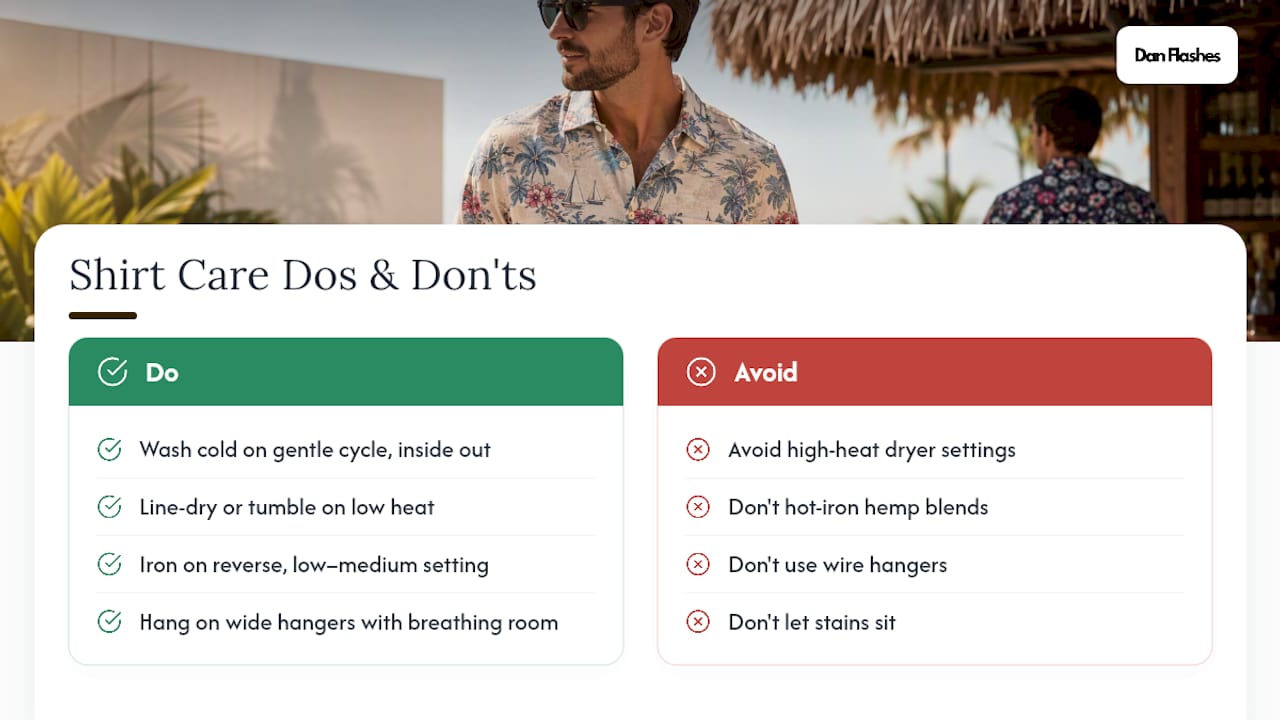
An aloha shirt that fades, shrinks, or wrinkles into a permanent crumple stops looking office-ready fast, no matter how well it fit on day one. Cotton and linen shirts hold their color and shape longest when washed in cold water on a gentle cycle, turned inside out to protect the print from friction against zippers or buttons on other garments.
Skip the dryer’s high heat setting entirely. Heat is what breaks down natural fibers and causes the shrinkage that turns a tailored fit into a snug one. Line-drying or a low-heat tumble cycle preserves both size and color far better, and it cuts down on the deep creasing that makes a shirt look slept-in by 10 a.m.
Ironing works, but on the reverse side, using a low to medium setting appropriate for cotton or linen. A press cloth helps if the print has any raised texture. For hemp blends, a quick steam often does more good than a hot iron, since steam relaxes wrinkles without flattening the weave’s natural texture.
Storage matters more than people think. Hang aloha shirts on wide wooden or plastic hangers rather than wire ones, which can leave shoulder dents that show up right where a blazer or cardigan won’t cover them. Give shirts breathing room in the closet. Fabric packed too tightly wrinkles faster and holds odors longer, which matters for a shirt in weekly office rotation.
Treat stains immediately rather than waiting for laundry day. A coffee spill or ink mark that sits for a week is far harder to lift than one treated within the hour, and repeated hard scrubbing on tropical prints can fade the dye faster than normal wear ever would.
Where Hawaiian Shirts Fly and Where They Fall Flat
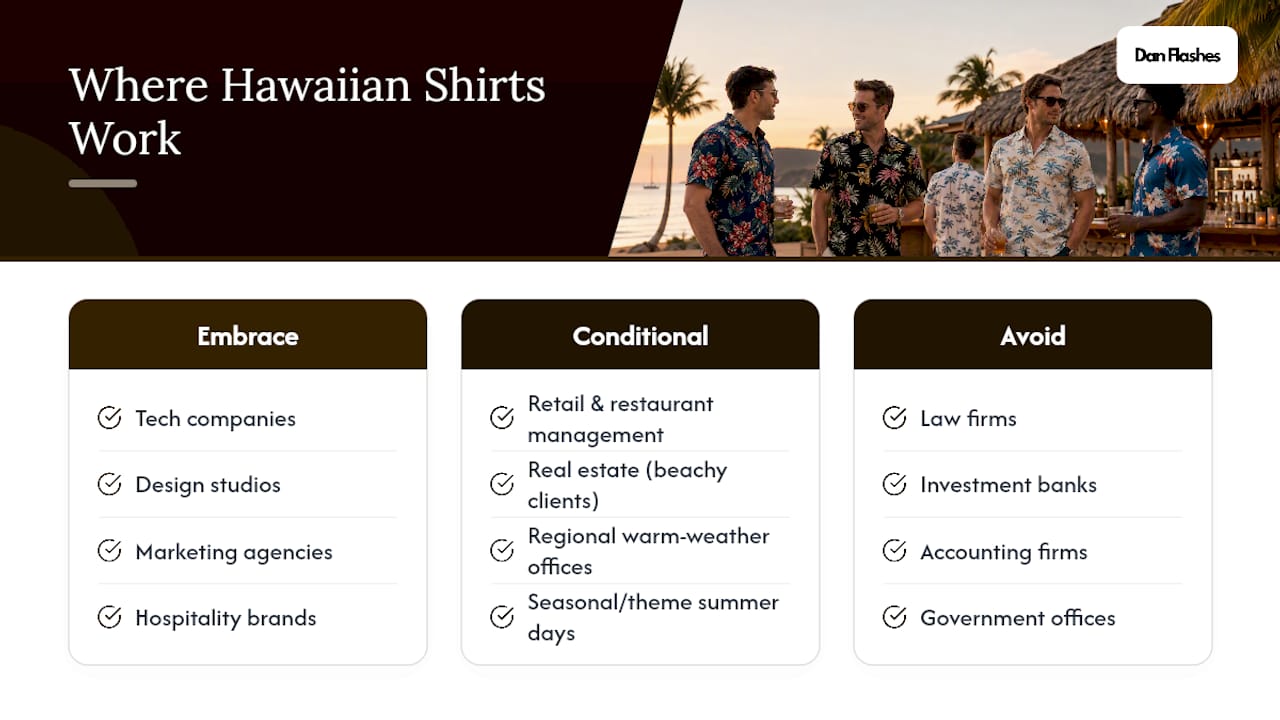
Tech companies, design studios, marketing agencies, and hospitality brands tend to be the friendliest environments for aloha shirts on Casual Friday. These industries generally build their culture around visible individuality, so a well-chosen print signals personality rather than carelessness. Startups in particular often treat a good aloha shirt as a mark of someone comfortable enough in their role to stand out a little.
Retail and restaurant management, real estate offices with a beachy client base, and regional offices in warm-weather markets also tend to embrace the look, sometimes even encouraging it as a seasonal theme days around summer holidays.
Law firms, investment banks, accounting firms, and government offices sit at the other end. These industries generally prize consistency and low visual risk, especially in client-facing or courtroom-adjacent roles, and even a subdued Hawaiian shirt can read as a misstep if leadership hasn’t visibly endorsed it. Healthcare administration and academic settings tend to land in the middle. Some embrace expressive Fridays; others stick to muted polos and button-downs regardless of the calendar.
The safest move in an unfamiliar office is to test the waters with the most restrained option you own before committing to a bolder print the following week.
Why Aloha Friday Still Matters Beyond the Shirt
Aloha Friday was never really about the shirt. It was about giving people a weekly signal that work could hold a little humanity, a little personality, without losing structure. That’s the same function Casual Friday quietly performs decades later, even for people who’ve never heard the phrase “Aloha Friday” in their lives.
Wearing one well means keeping both halves of that intention alive: the ease and the respect. Pick a print you’d be glad to explain, wear it like it means something, and Casual Friday starts to feel less like a loophole and more like a small, deliberate choice.
- Dan Flashes
Shop Office-Ready Aloha Shirts From Dan Flashes
These shirts are described as designed to transition from casual settings to office environments, using natural and sustainable fabrics rather than thin polyester often associated with lower-quality prints.
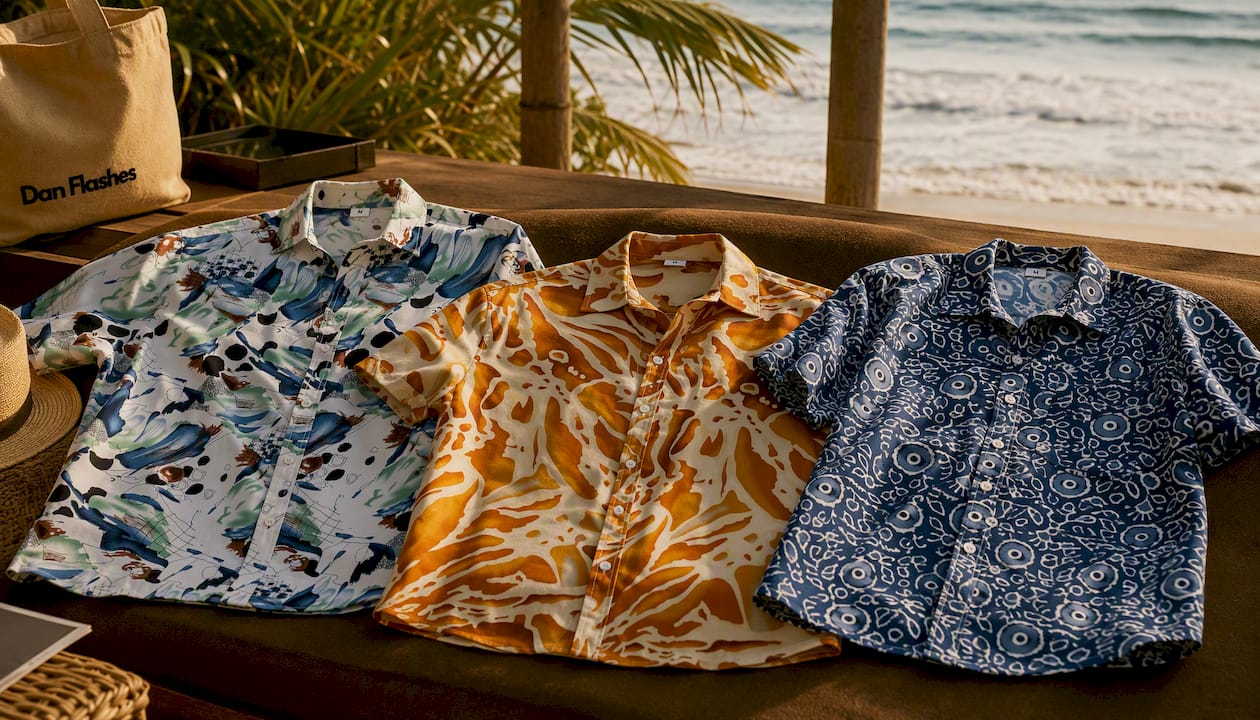
Three styles map directly onto the Triple-S Standard covered above. The Hawaiian Pattern Shirt offers a structured cotton button-up with a restrained repeat pattern that reads well under an open blazer. The Pattern Hawaiian Shirt leans into subtler, smaller-scale motifs for readers whose office skews conservative. The Tropical Hawaiian Pattern Shirt works for teams with more relaxed norms, where a slightly bolder tropical print still lands as intentional rather than loud.
Before you check out, run the same shopping checklist covered earlier: confirm the fabric listed is cotton, linen, or bamboo hemp, check that the print scale looks small in the product photos, and pick a colorway that reads muted rather than neon. Every order carries a 30-day money-back guarantee, so getting the fit or palette wrong costs you nothing but a returns label. Browse the full Hawaiian shirts collection or the patterned shirts line to compare options side by side, and start building a Casual Friday rotation that actually holds up at work.
Sources
- Business Casual Hawaii: The Complete 2026 Guide for Men
- Aloha Friday - Wikipedia
- Happy Aloha Friday: What it is and how you can celebrate like a local
- Are Hawaiian shirts business casual? Style and guidance
- Rearview Mirror: Aloha Friday might have led to global Casual Friday trend
FAQ
Is Hawaiian Shirt Friday a Real Thing?
Yes, it started as Aloha Friday in Hawaii in the mid-1960s, promoted by the Hawaii Fashion Guild to encourage local businesses to allow aloha wear one day a week. That practice is widely credited as the root of today’s Casual Friday tradition on the mainland.
What Does Wearing a Hawaiian Shirt on Fridays Mean?
It traces back to a deliberate campaign to loosen Hawaii’s business dress code, not a random fashion fad. Wearing one today, especially a restrained print in quality fabric, signals comfort with self-expression while still respecting a professional setting.
Is It Culturally Insensitive to Wear a Hawaiian Shirt?
It isn’t inherently insensitive, but the print you choose matters. Opt for designs rooted in identifiable plants or patterns rather than generic tourist graphics, and avoid anything that treats sacred symbols as a costume, as cultural guides on aloha’s deeper meaning recommend.
Can You Wear Hawaiian Shirts Casually Outside of Work?
Absolutely. Bolder prints, brighter palettes, and looser fits all work fine for weekends, vacations, and parties. Danflashes’ tropical and palm print collection is built for exactly that kind of casual wear, while office days call for the more restrained styles covered above.
Is a Hawaiian Shirt Considered Business Casual?
It depends entirely on the workplace and how the shirt is styled. In creative industries or in Hawaii itself, a well-chosen aloha shirt often qualifies as business casual outright; in conservative, client-facing industries, it usually doesn’t unless the print is extremely subdued.


