

Viscose is one common type of rayon, not a separate fabric. For shirt shoppers, the label matters less than the subtype, the fabric weight, and the finishing. A shirt tagged “rayon” and one tagged “viscose” can be nearly identical, or wildly different, depending on whether the maker used a viscose process, a modal process, or a lyocell process. Skip the label debate and check the weight, the weave, and the care tag instead.
TL;DR:
- Viscose is a chemical process used to produce most rayon fabrics, which vary in feel, strength, and durability depending on the subtype and finishing.
- Standard viscose has a silk-like sheen, drapes fluidly, but loses much of its wet strength, making it prone to stretching, wrinkling, and shrinking during washing.
- Modal and lyocell (TENCEL) are refined rayon subtypes that offer better wet strength, less shrinkage, and improved durability for frequent washing or travel use.
- Fabric weight (GSM) and construction influence performance more than fiber type, with mid-weight fabrics (120-180 GSM) being ideal for most shirts.
- Proper care involves gentle washing, reshaping, and air drying to prevent damage, especially for viscose and standard rayon fabrics.
Table of Contents
- Viscose vs Rayon Shirts: Are They Really the Same Fabric?
- Feel, Drape, and Durability: Comparing Viscose and Rayon Fabric for Shirts
- How to Pick the Right Fabric for a Viscose or Rayon Shirt
- Caring for Rayon and Viscose Shirts Without Ruining Them
- Sustainability and Worker Safety Behind Viscose Production
- Modal, Lyocell, and Blends: The Rayon Family Beyond Viscose
- Why Dan Flashes Weighs Fabric Choice the Way It Does
- Find Your Fit: Dan Flashes Shirts Built Around These Same Fabric Priorities
- Sources
- FAQ
Viscose vs Rayon Shirts: Are They Really the Same Fabric?
They’re the same family, and in the United States, they’re often the same fabric wearing two different names. Rayon is the umbrella category: any fiber made by dissolving natural cellulose and regenerating it into a new fiber form. Viscose describes the specific chemical process used to make most of that rayon, so nearly every “rayon shirt” you’ve owned was actually made using the viscose method.
The raw material is usually wood pulp, though bamboo and cotton linter show up too. Manufacturers dissolve the cellulose in a chemical bath, force it through spinnerets, and regenerate it into filaments that get woven or knit into fabric. That’s what makes rayon “semi-synthetic”: the starting material is natural, but the fiber itself is manufactured, not grown.
The Federal Trade Commission allows apparel makers to use “rayon” and “viscose” interchangeably on US labels, which is exactly why the terms blur together on hang tags. That guidance matters most when you see “bamboo viscose” on a shirt, since the FTC has flagged vague bamboo marketing that skips over the actual manufacturing process.
Rayon’s family tree has more than one branch worth knowing:
- Viscose rayon - the standard, most common process; soft, breathable, and prone to losing strength when wet.
- Modal - a high-wet-modulus rayon engineered for better shrink resistance and machine-wash durability.
- Lyocell (often sold as TENCEL) - made with a closed-loop solvent system that recovers roughly 99% of the solvent, giving it stronger wet performance and a lower-impact production footprint.
Textile guides increasingly stress that the subtype and finishing matter more than which name lands on the tag. A modal blend and a classic viscose weave can both say “rayon” and behave like completely different shirts on your body and in your wash.
Feel, Drape, and Durability: Comparing Viscose and Rayon Fabric for Shirts
Hand feel is where viscose earns its reputation. Standard viscose rayon has a silk-like sheen and a cool, smooth touch against skin, which is why it shows up so often in dressy camp-collar shirts and flowy resort styles. Other rayon subtypes, especially modal, tend toward a more matte, cotton-like finish. Weave and finishing treatments shift that perception further. A tightly woven challis feels different from a loosely knit rayon jersey, even if both started from the same fiber.
Drape is the other reason viscose dominates warm-weather shirting. The fiber falls close to the body and moves with it instead of standing stiff, which is exactly the quality that makes a Hawaiian print pop instead of looking boxy. That fluidity is also why viscose challis and voile show up constantly in summer garment construction rather than heavier cotton twill.
Durability is where things get more honest. Wet strength is the real limitation across the whole rayon family, not just viscose specifically.
The fiber fact that changes how you wash: Viscose fibers lose a significant portion of their strength when saturated with water, which is why a machine’s spin cycle can stretch or distort a viscose shirt in ways it never would to cotton. Manufacturers typically cut viscose fibers to about 38 millimeters to mimic cotton’s length, with higher-end grades running 40 to 51 millimeters, and longer staple length generally means a smoother, more durable finished fabric.
Modal and lyocell were engineered specifically to fix this weakness. Both hold up far better under machine washing than classic viscose, which is why a lot of everyday rayon tees have quietly shifted to modal blends over the past decade.
Shrinkage and wrinkling follow the same logic. A lightweight woven viscose shirt wrinkles fast and can shrink noticeably on its first wash if it wasn’t preshrunk at the mill. A heavier knit, or a modal blend, resists both far better. GSM (grams per square meter) plays a bigger role here than most shoppers realize:
- Low GSM (under 100) - floaty, sheer-leaning, wrinkles easily, best for handwashing.
- Mid GSM (120 to 180) - the sweet spot for most woven shirts, balancing drape with enough body to survive normal handling.
- Knit constructions - generally more forgiving of machine washing than wovens at the same fiber content, thanks to the stretch in the loop structure.
How to Pick the Right Fabric for a Viscose or Rayon Shirt
Buying a shirt off a product page means reading past the fiber name and into the specs that actually predict how it will wear. Here’s the order that matters:
- Match GSM to the shirt’s job. Airy, drapey woven shirts land best around a lightweight to mid-weight fabric range appropriate for airy shirts, while knits and structured pieces want closer to 120 to 180 GSM for enough body to hold their shape.
- Pick the subtype based on how often you’ll wash it. A shirt you’ll hand wash occasionally, like a dressy resort piece, can be standard viscose. A shirt going into weekly rotation should lean modal or lyocell.
- Favor viscose when print clarity and drape are the priority. Bold tropical and floral patterns read more vividly on viscose’s smooth, absorbent surface than on stiffer cotton weaves, which is part of why lightweight viscose construction remains a go-to for resort shirting.
- Favor modal or lyocell for frequent washing and travel. Both resist shrinkage and stretching better across repeated machine cycles, which matters if the shirt is coming with you on a trip and getting washed in a hotel sink.
- Check the product page for four things before you buy: the GSM, the specific subtype (not just “rayon”), the printed care instructions, and any sourcing or certification detail. A tag that just says “rayon, machine wash cold” without a GSM or subtype is telling you less than it should.
Dan Flashes’ own comparison of rayon against cotton for Hawaiian shirts walks through this exact tradeoff in more depth if you’re deciding between the two base fibers for a specific print.
Caring for Rayon and Viscose Shirts Without Ruining Them
Low wet strength is the single fact that should drive every laundry decision you make with these shirts. Treat a viscose shirt like it’s more fragile than cotton when it’s wet, because it is.
The safest routine looks like this:
- Hand wash, or use a gentle cold cycle in a mesh bag if the machine is unavoidable.
- Skip the high spin setting. Low spin or none at all prevents the stretching that ruins fit.
- Reshape while damp, then lay flat or hang to dry rather than tossing it in a dryer.
- Iron on low heat with steam only if wrinkles are stubborn, and always check the care tag first.
- Send it to a dry cleaner for tailored or heavily embellished pieces where structure matters more than convenience.
Modal and lyocell shirts tolerate machine washing noticeably better than standard viscose, so if your care tag specifically says modal or TENCEL, you can generally trust a normal cold cycle.
Pro Tip: Run a new viscose or rayon shirt through one gentle wash before the first wear. Sewists routinely prewash rayon fabric before cutting garments specifically because these fibers shrink most on that first exposure to water, and doing it on purpose beats discovering it after a night out.
Sustainability and Worker Safety Behind Viscose Production
Classic viscose production has a real environmental cost, and it’s worth knowing before you assume “rayon” is automatically the eco-friendly choice over synthetics. Standard viscose manufacturing uses carbon disulfide, a chemical that carries documented worker-safety and wastewater concerns when factories run older, open-loop systems without proper controls.
Lyocell breaks from that pattern in a meaningful way. Its solvent, NMMO, runs through a closed-loop system that recovers the vast majority of the chemical for reuse rather than releasing it as waste. Modal’s production has also improved over the years, closing some of the gap with lyocell, though it doesn’t match lyocell’s closed-loop recovery.
Practical signals to look for when you shop:
- TENCEL branding specifically indicates Lenzing’s lyocell or modal fibers, which carry more transparent environmental claims than generic “rayon” or “viscose” tags.
- Certifications and mill transparency matter more than the word “sustainable” printed on a tag with no supporting detail.
- Paying more for lyocell or modal is often justified when the shirt will see heavy rotation, since you get both a lower environmental footprint and better durability for the premium.
Modal, Lyocell, and Blends: The Rayon Family Beyond Viscose
Modal earns its place in a rotation shirt drawer specifically because of wet strength. It holds up to machine washing far better than standard viscose, which makes it the better call for tees and everyday button-ups that see the laundry weekly rather than the occasional hand wash.
Lyocell, sold widely under the TENCEL name, goes a step further. Its closed-loop production and strong moisture transport make it a smart pick for hot sleepers, humid climates, and travel shirts that need to dry fast between wears.
Blends change the equation again. Adding cotton to a viscose shirt boosts durability and machine-wash tolerance at some cost to drape. Linen blends add texture and breathability but wrinkle more aggressively. Bamboo hemp blends, which Dan Flashes uses in several of its own lines, tend to land in between: sturdier than pure viscose, with a softer hand than straight linen.
Why Dan Flashes Weighs Fabric Choice the Way It Does
Fabric decisions on a Hawaiian shirt come down to a short list of priorities: does the fiber hold drape without going limp, does the print stay sharp after repeated washes, and does the finished shirt survive a summer of actual wear. Those questions matter more than which name sits on the care tag, and that’s the same logic this guide has walked through section by section.
Some brands lean on cotton, linen, and sustainable bamboo hemp across their lineups for a balance of print clarity and better wash durability than standard viscose alone. For a closer look at how bamboo hemp stacks up against classic rayon on weight and handling, the brand’s breakdown of 160 to 190 GSM resort shirts covers the tradeoff in more detail, and the lightweight summer shirt guide digs into breathability specifically.
- Dan Flashes
Find Your Fit: Dan Flashes Shirts Built Around These Same Fabric Priorities
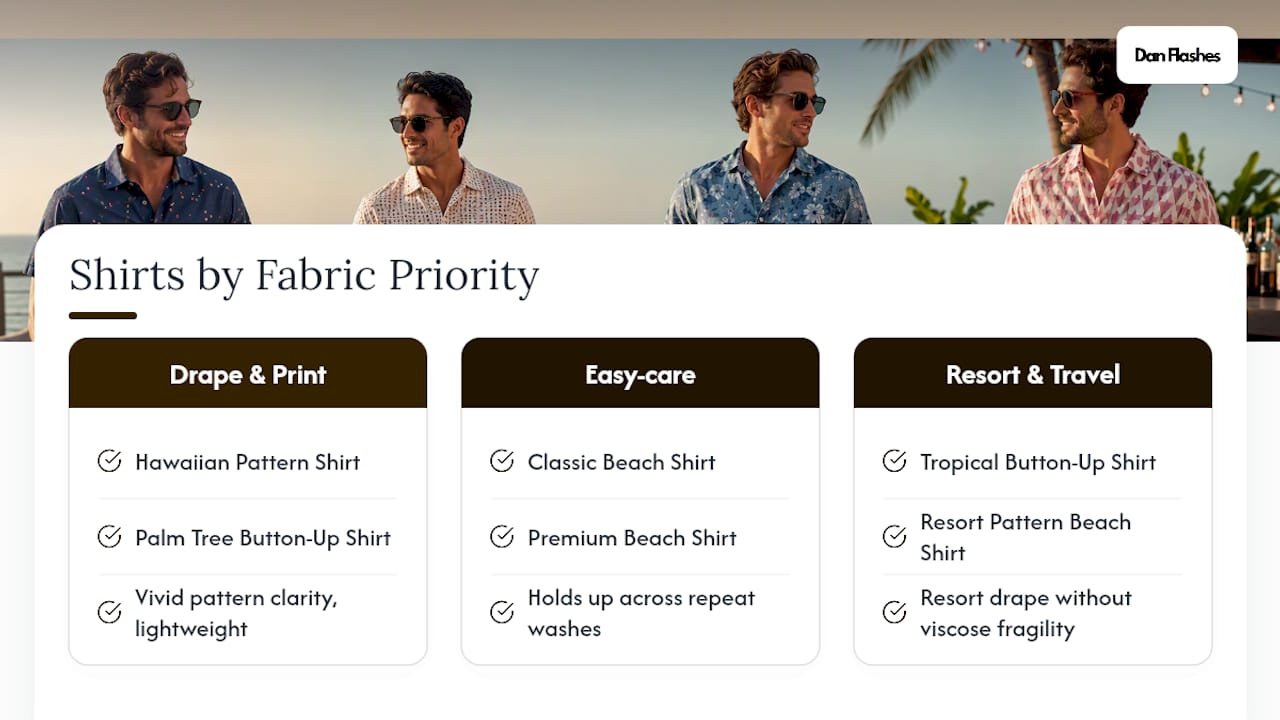
Everything covered above, drape, print clarity, wet strength, and easy care, maps directly onto how Dan Flashes builds its shirt lineup. The brand’s shirts run in cotton, linen, and sustainable bamboo hemp rather than standard viscose, which means you get the drape and bold pattern definition shirt shoppers want without the wet-strength fragility that makes classic viscose a pain to wash.

If drape and vacation-ready print detail are the priority, the Hawaiian Pattern Shirt and Palm Tree Button-Up Shirt show off exactly the kind of vivid pattern clarity that lightweight fabrics do best. For an everyday summer rotation where easy-care matters more than a dressy finish, the Classic Beach Shirt and Premium Beach Shirt hold up better across repeat washes. Travelers chasing that resort feel without the fragility of viscose should look at the Tropical Button-Up Shirt or Resort Pattern Beach Shirt, both built for the same fluid movement viscose is known for, minus the wash-day anxiety.
Many shirts come with deals like buy 3 get 1 free and a 30-day money-back guarantee, so testing a fabric against your own laundry routine can be low risk. Browse the full Hawaiian shirt collection and pick the piece that matches how you actually plan to wear and wash it.
Sources
For deeper technical detail, the FTC’s bamboo textile guidance covers labeling rules, Sleep Foundation’s viscose versus rayon breakdown compares washability, and Swicofil’s viscose properties page details fiber-level specs like staple length and wet strength.
FAQ
Is Viscose Better Than Rayon?
Viscose is a type of rayon, not a competing fabric, so the comparison isn’t really “better” but “which subtype.” Modal and lyocell, both members of the rayon family, generally outperform standard viscose on wet strength and washability, according to Sleep Foundation’s comparison.
What Are the Disadvantages of Viscose Rayon?
The biggest drawback is low wet strength, which means the fiber can stretch, distort, or tear more easily when saturated with water during washing. It also wrinkles readily and can shrink on its first wash if it wasn’t preshrunk, which is why prewashing before wear or sewing is standard advice.
Is Viscose Basically Plastic?
No. Viscose starts from natural cellulose, usually wood pulp, that gets chemically dissolved and regenerated into fiber form, which is why it’s classified as semi-synthetic rather than a true synthetic like polyester. The manufacturing process uses chemicals, but the base material is plant fiber, not petroleum.
Is Viscose Rayon Cheap Quality?
Not inherently. Quality depends far more on staple length, weave, and GSM than on the fiber name itself. A well-constructed viscose challis at a solid GSM can outperform a poorly finished modal or cotton shirt, which is why checking the fabric weight and construction matters more than the label when judging quality.


