

Eco fashion certifications are third-party verification systems that confirm specific, auditable claims about a garment, from organic fiber content to factory labor conditions to chemical safety. No single label covers everything. If you’re checking a hangtag, the two that matter most for different reasons are the Global Organic Textile Standard (GOTS), which verifies organic fiber and processing integrity, and OEKO‑TEX Standard 100, which tests the finished product for harmful substances. Add a labor or holistic label like Fair Trade or B Corp, and you’ve got a fuller picture. Scope varies wildly between them, so read past the logo.
TL;DR:
- GOTS requires at least 95% organic fiber content and chain-of-custody documentation to verify full organic integrity from farm to finished garment.
- OEKO‑TEX Standard 100 tests finished products for roughly 300 harmful substances but does not verify fiber origin or labor conditions.
- Certification claims based on mass-balance models or lacking certification numbers can be misleading, especially if certificates are outdated or incomplete.
- Combining multiple labels, such as GOTS, OEKO‑TEX, and factory audits, provides a more comprehensive assurance of sustainability and ethical standards.
- Certificates like Fair Trade or Fair Wear focus on labor conditions, but only verify factory practices, not chemical safety or fiber origin.
Table of Contents
- What Do Eco Fashion Certifications Actually Cover?
- Certification Categories, at a Glance
- Which Certifications Matter Most, and What Do They Actually Verify?
- How Do You Verify a Certification Claim Before You Buy?
- Where Do Eco Fashion Certifications Fall Short?
- Dan Flashes: Applying Certification Thinking to Everyday Shirts
- Shop Shirts Made With Sustainability in Mind
- Sources
What Do Eco Fashion Certifications Actually Cover?
Every certification verifies something narrow, not everything at once. Some test the finished garment for chemical residue. Others audit farms, dye houses, or entire supply chains. A few look only at company governance and never touch the fabric at all. Confusing one type for another is the single biggest reason shoppers misread a hangtag.
Three verification models dominate the space:
- Product-level testing checks the finished item, usually for harmful substances, as OEKO‑TEX Standard 100 does.
- Supply-chain or process audits examine how a fiber gets turned into a garment, including dye houses, wet processing, and chemical handling, which is where standards like Bluesign operate.
- Farm or fiber-level standards verify conditions at the source, such as land management for cotton or welfare protocols for wool and down.
Chain-of-custody tracking is what connects those three stages. Without it, a certifier can confirm a farm grew organic cotton but has no way to prove that exact cotton ended up in your shirt rather than a warehouse blend. That’s why the strongest certifications require documentation at every handoff, not just a one-time farm inspection. If you care about chemical safety on skin-contact clothing, look for OEKO‑TEX. If you care about organic integrity from farm to finished shirt, look for GOTS. If you care about who sewed the garment and under what conditions, you need a labor standard like Fair Trade or Fair Wear, because none of the fiber or chemical certifications touch factory labor at all.
Certification Categories, at a Glance
Certifications cluster into six broad categories, and knowing which bucket a label falls into tells you what it can and cannot promise.
- Material and organic: GOTS and Organic Content Standard verify fiber origin and require minimum organic content thresholds, typically with chain-of-custody documentation through spinning, dyeing, and cutting.
- Finished-product safety: OEKO‑TEX Standard 100 tests the completed garment for a long list of restricted substances, using stricter limits for items worn against skin like undershirts and baby clothing.
- Animal welfare: Responsible Wool Standard (RWS) and Responsible Down Standard verify farm-level treatment of animals but stop at the farm gate, meaning they don’t guarantee anything about how the fiber is later dyed or processed.
- Recycled and circular: Global Recycled Standard (GRS) and Recycled Claim Standard (RCS) verify recycled input percentages through chain-of-custody audits, while Cradle to Cradle goes further and certifies for full-circularity design.
- Social and labor: Fair Trade, Fair Wear Foundation, and SA8000 audit wages, working hours, and factory conditions, usually through unannounced inspections.
- Holistic or company-level: B Corp certifies the business as a whole, covering governance, worker treatment, and environmental impact, but it does not test individual garments for organic content or chemical safety.
A garment can carry a chemical-safety label and still have been sewn in a factory with no independent labor audit. That gap is exactly why buyers who want fuller assurance usually stack two or three labels rather than trusting one.
Which Certifications Matter Most, and What Do They Actually Verify?
Here’s where the labels get specific enough to actually compare.
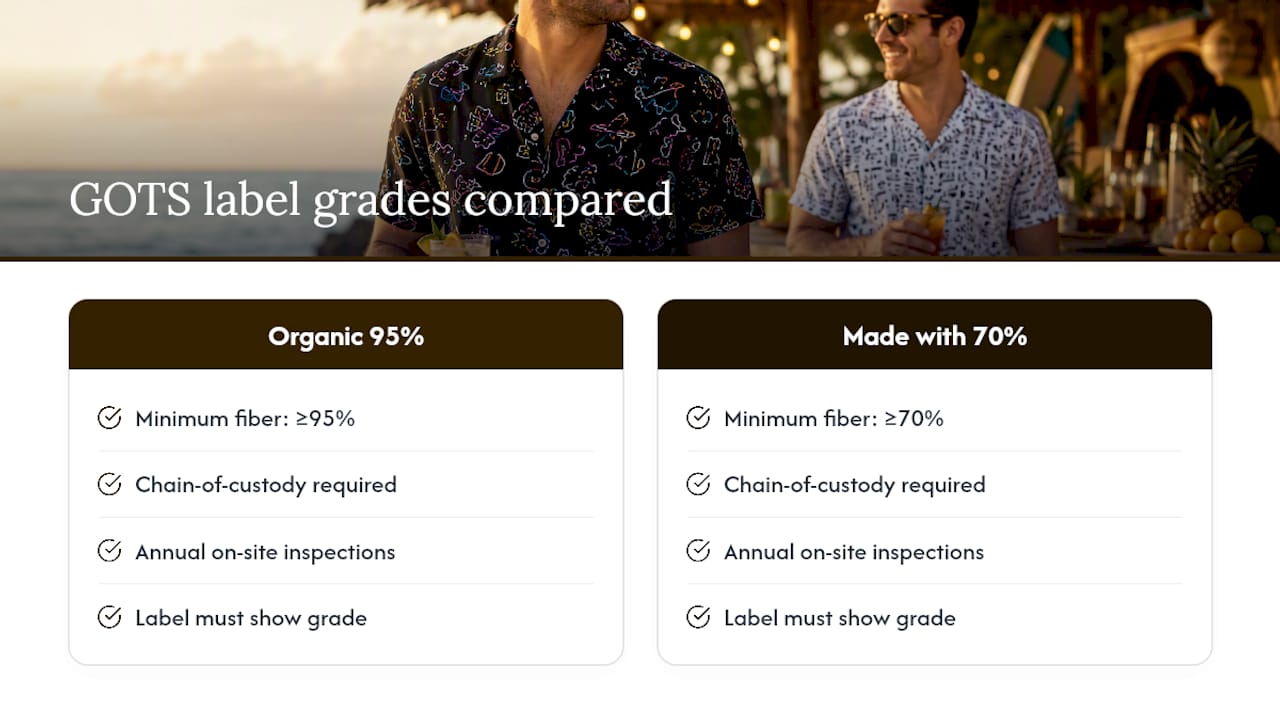
GOTS is the most rigorous fiber-to-finished-product standard in apparel. It requires a minimum organic fiber content threshold for “made with organic” claims and a higher threshold for a straight “organic” claim, and it mandates chain-of-custody documentation and annual on-site inspections at every processing stage. GOTS v8.0 was released in March 2026, and audits conducted under the new version take effect starting March 1, 2027, which matters if you’re comparing a hangtag issued before or after that transition. The standard also specifies required label elements, including the label grade, the approved certification body’s name, and a certification number that shoppers can check against a public registry. A GOTS label missing that certification number is a red flag worth noting.
OEKO‑TEX Standard 100 and Made in Green work differently. Standard 100 tests the finished textile for roughly 300 potentially harmful substances, with stricter thresholds for products classified for direct skin contact, like a soft cotton shirt versus, say, upholstery fabric. Made in Green builds on that by adding facility-level verification and traceability, letting a shopper scan a product ID or QR code to see where and how the item was made. Neither certification says anything about whether the fiber was organic.
Better Cotton Initiative (BCI) funds training for farmers to grow cotton more sustainably, but it commonly operates on a mass-balance model. That means a brand can source a volume of BCI-verified cotton globally and still not have any of that specific cotton in the shirt you’re holding. Independent assessments have flagged this as a source of real shopper confusion, and BCI has signaled plans to shift toward stronger physical traceability in coming seasons. If physical certified fiber in your specific garment matters to you, look for “segregated” or “identity preserved” chain-of-custody wording instead of a general BCI claim.
Statistic Callout: GOTS requires organic content of at least 95% for a garment to carry the “organic” label grade, and at least 70% for the “made with organic” grade. That 25-point gap between the two label grades is exactly why reading the fine print under the logo matters more than the logo itself.
Bluesign focuses on the manufacturing stage, screening chemical inputs before they ever reach the dye house or finishing line, which makes it a strong complement to fiber-only standards. Global Recycled Standard (GRS) and Recycled Claim Standard (RCS), both managed under Textile Exchange, verify recycled content through chain-of-custody audits; Textile Exchange currently oversees more than 30 approved certification bodies across its standards and is consolidating several of them into a single Materials Matter Standard to simplify sourcing claims over time.
On the labor side, Fairtrade International and Fair Trade USA are separate systems with separate verification bodies. Fairtrade International mandates living-wage implementation within a defined timeline in applicable contexts and uses independent bodies like FLOCERT for verification, while Fair Trade USA’s Factory Production Standard certifies factories against more than 100 compliance criteria spanning social responsibility, environmental practices, and worker empowerment, backed by a public, searchable list of certified factories.
RWS and RDS verify animal welfare at the farm level only, so they’re often paired with GOTS or OEKO‑TEX to cover what happens after shearing. Cradle to Cradle takes the widest lens of any label here, certifying products across five categories, including material health, reutilization potential, renewable energy use, water stewardship, and social fairness, with tiered certification levels reflecting how well a product performs in each. B Corp, by contrast, certifies the company, not the garment, evaluating governance and overall impact without testing a single fiber. Newer integrated frameworks are emerging that try to bundle environmental, labor, and consumer-safety criteria into one scorecard, though none has yet reached the recognition level of GOTS or OEKO‑TEX.
How Do You Verify a Certification Claim Before You Buy?
A logo on a hangtag proves nothing by itself. Here’s the sequence worth following before you trust one:
- Find the certifier’s name and certification number. GOTS labels are required to display the certification body and a number you can cross-check against a public registry.
- Check the chain-of-custody model. “Segregated” or “identity preserved” means the certified material is physically in your garment; “mass balance” means the brand purchased an equivalent volume elsewhere in its supply chain.
- Match the label to your priority. Use OEKO‑TEX for anything worn close to skin, GOTS or GRS for organic or recycled content claims, and Fair Trade or Fair Wear when labor conditions are your main concern.
- Ask the brand direct questions if the product page only says “sustainably made” with no certifier named. That phrase alone verifies nothing.
- Watch for missing scope certificates. A legitimate certification usually has a corresponding public scope certificate listing exactly which products or facilities it covers.
Pro Tip: Stack labels instead of picking one. A shirt carrying GOTS for the fiber, OEKO‑TEX for chemical safety, and a public scope certificate for the factory gives you three independent checks instead of one, and each covers a gap the others leave open.
If you want more background on how fiber choice shapes these claims in the first place, our breakdown of sustainable fabric options walks through what organic cotton and bamboo hemp actually require to earn that label.
Where Do Eco Fashion Certifications Fall Short?
The biggest risk isn’t a fake label. It’s a real certification stretched to imply more than it actually covers. Mass-balance accounting is the clearest example: a brand can legitimately claim it purchased a volume of certified cotton without any of that cotton reaching the specific shirt on the rack, and that gap is a well-documented source of shopper confusion.
Watch for these dilution patterns:
- Brand-level sourcing percentages (“30% sustainable materials”) that don’t specify which products contain them.
- Logos displayed without a certification number or any link to a public registry entry.
- Vague language like “eco-conscious” or “responsibly made” with no named certifier at all.
- Certificates that are years out of date, since most standards require annual re-audits to stay valid.
Statistic Callout: GOTS-required label elements, including the label grade, certification body name, and certification number, exist specifically so a shopper can verify a claim independently. A product missing all three of those elements is asking you to trust it on faith alone.
Stronger trust signals include an accredited certification body, a publicly posted scope certificate, and a traceable product ID or QR code, the kind Made in Green uses. When in doubt, look the certifier up directly rather than taking a swing tag’s word for it.
Dan Flashes: Applying Certification Thinking to Everyday Shirts
Dan Flashes builds its shirts from cotton and sustainable bamboo hemp, and the same logic in this guide shapes how we think about material sourcing. Bamboo hemp requires less water and fewer chemical inputs to process than conventional cotton, which is one reason it shows up across our floral and pattern shirt lines. We’re transparent that not every shirt in the catalog carries a formal third-party certification, and we’d rather say that plainly than lean on vague “eco-friendly” language the way some brands do.
Understanding what GOTS, OEKO‑TEX, and GRS actually test makes it easier for any shopper, on our site or anywhere else, to ask sharper questions before buying. That’s a better outcome than a hangtag nobody reads closely.
- Dan Flashes
Shop Shirts Made With Sustainability in Mind
If you’ve made it this far, you already know that a shirt made from cotton or bamboo hemp isn’t automatically “sustainable” just because a tag says so. That’s exactly why Dan Flashes leans on named materials, not vague slogans: our Hawaiian Pattern Shirt and Tropical Hawaiian Pattern Shirt list their fabric composition right on the product page, so you know what you’re buying before checkout.

Beyond material transparency, every order comes with a 30-day money-back guarantee and discount bundles, so trying a bolder print costs less than committing to one shirt at full price. Browse the full beach shirt collection for options like the Classic Beach Shirt and Premium Beach Shirt, or check the Resort Pattern Beach Shirt and Vintage Stripe Summer Shirt if you want something built for warm-weather rotation. If organic cotton content is your priority, our organic cotton shirt guide explains what to look for, and pairing that knowledge with our fabric care advice, similar to the durability tips in this partner guide on quality swimwear, will help any warm-weather piece last longer. Pick a print, check the material notes on the product page, and place your order knowing exactly what you’re wearing.


