

The five features that matter most are long-staple two-ply cotton, single-needle stitching with a dense stitch count, a collar that springs back into shape, matched patterns at the seams, and buttons that resist heat and cracking. Fit still decides whether a shirt earns its price. Every check below takes seconds and needs nothing but your hands and a close look.
TL;DR:
- Shirts with long-staple cotton and two-ply yarns in the 80s to 120s range tend to be more durable, softer, and less prone to pilling.
- Single-needle stitching with 18 to 23 stitches per inch and precise pattern matching indicate careful construction that lasts longer.
- Proper fit depends on a collar that fits comfortably, shoulder seams at the shoulder bone, and armholes that reduce fabric drag.
- Key details include matched patterns at seams, sturdy buttons, interior seam finishing, and reinforced hems and gussets.
- Fabric quality and fit are far more important than hand-finished buttonholes or unfused collars for overall shirt longevity and comfort.
Table of Contents
- Quality Shirt Features You Can Check in 30 Seconds
- Fabric, Fiber, and Weave: What to Choose for Durability and Feel
- Construction Details: Stitching, Seams, Collar, Cuff, and Buttonwork
- Fit and Measurements: The Checks You Cannot Skip
- A Practical Inspection: 6 Close-Up Checks That Confirm Quality
- How to Verify Quality Features Before Buying
- Common Fabric Types Behind High-Quality Shirts
- Environmental and Ethical Considerations in Shirt Manufacturing
- Shirt Finishes: Mercerization, Sanforization, and What They Actually Change
- The Trade-Off Nobody Tells You About Quality Shirts
- Compare a Product Before Ordering
- Sources
Quality Shirt Features You Can Check in 30 Seconds
You don’t need a tailor’s eye to spot a well-made shirt. You need thirty seconds and a willingness to touch the fabric before you touch the price tag.
- Pinch the fabric between two fingers. A quality cotton feels dense and slightly cool, not papery or waxy. Cheap cotton often feels thin because it’s woven from short fibers packed loosely to hit a price point.
- Flip the shirt inside out and check the seams. A single row of stitching with no second parallel line means single-needle construction, the mark most trade sources point to first, per SARTORO’s breakdown of dress shirt quality.
- Press the collar flat, then let go. It should spring back into a rolled shape immediately. If it stays flat or ripples, the interlining is failing.
- Line up the plaid or floral print at the pocket and shoulder seam. Matched patterns signal a factory that cared about cutting layout, not just output speed.
- Twist a button between your fingers. Real shell buttons feel cool and slightly heavy. Plastic feels warm almost instantly.
- Count the spare buttons inside the placket. Their presence, even one extra, is a small but telling sign the maker expected you to keep the shirt for years.
Each check maps to a bigger construction story, and the sections below unpack why they matter.
Fabric, Fiber, and Weave: What to Choose for Durability and Feel
Fabric is where shirt quality either starts or dies before the first button gets sewn on. Long-staple cotton uses fibers roughly 1.5 inches or longer, which spin into smoother, stronger yarn with fewer weak points where the fabric can pill or tear. Short-staple cotton, spun from shorter fibers, produces the rougher, fuzzier weave you feel in bargain-bin shirts after two washes.
Two-ply yarn twists two single strands together before weaving, which adds strength and a smoother surface compared to single-ply cloth. A sensible baseline for shoppers is a fabric in the 80s to 120s two-ply range. Anything advertised well above that, like 200s, usually trades durability for a slippery hand that wears thin faster than the marketing suggests.
Weave changes how the shirt behaves as much as fiber does:
- Broadcloth or poplin uses a tight, plain weave that produces a smooth, slightly lustrous surface. It’s the standard for dress shirts and drapes cleanly.
- Twill weaves in a diagonal rib, giving the fabric more texture, better wrinkle resistance, and a slightly heavier drape, common in shirts meant for daily wear.
- Oxford uses a basket weave with visible texture and more breathability, favored for casual and button-down collar shirts.
Non-iron finishes deserve a skeptical look. The resin treatments that keep a shirt wrinkle-free also stiffen the hand of the fabric and can reduce breathability over repeated washes. You’re trading feel and airflow for less time behind an ironing board, which is a fair trade for some buyers and a bad one for anyone who prioritizes comfort in humid climates.
For warm-weather shirts specifically, cotton and bamboo hemp blends solve a different problem: they keep the breathability of a natural fiber while adding a bit more drape and moisture handling than straight cotton offers, which matters more on a beach shirt than a dress shirt. If you want a deeper look at how material choice affects comfort in casual and printed shirts, Dan Flashes covers fabric selection for warm-weather wear in more detail.
Construction Details: Stitching, Seams, Collar, Cuff, and Buttonwork
This is where a shirt either earns its price or hides how it cut corners. Construction is mostly invisible from three feet away and completely obvious up close.
Stitching type and density. Single-needle stitching sews one row at a time using a lockstitch, which holds firm even if one stitch fails. Twin-needle machines run two parallel rows using a chain stitch that’s faster to produce but prone to unraveling if a single loop breaks, according to Londa’s comparison of single and double-needle tailoring. Quality shirts also run a tighter stitch count, generally in the range of 18 to 23 stitches per inch, which resists puckering along the seam.
Flat-felled seams, split yokes, and gussets. A flat-felled seam folds the raw edge under itself and stitches it flat, so there’s no exposed fray inside the shirt. A split yoke, the panel across the upper back, is cut in two pieces instead of one, which lets the maker match a pattern across the seam and accommodate uneven shoulders more naturally, a detail Gentleman’s Gazette flags as typical of higher-end construction. Underarm gussets, small reinforcing squares of fabric, reduce stress at the point where the side seam meets the sleeve, a spot that tears first on cheaper shirts.
Button quality and attachment. Mother-of-pearl buttons resist heat and chemical damage better than plastic and hold their luster through years of washing, according to Tissura’s overview of mother-of-pearl buttons. Look at how the button is sewn on: a shank stitch, which raises the button slightly off the fabric on a thread stem, keeps stress off the threads when you button up. A cross or lily stitch pattern is a visual tell of hand or careful reinforced attachment. Buttonholes matter too. Cut-first buttonholes, sewn with a dense zigzag around a clean-cut slit, resist fraying far longer than buttonholes stitched around fabric that’s punched afterward.
Removable collar stays. These small plastic or metal inserts slide into slots at the collar points and keep them flat under a jacket or in wind. Removable stays let you wash the shirt without warping or losing them, a small but practical upgrade over sewn-in stays that eventually bend out of shape.

Pro Tip: Turn the collar over and look at the interlining edge. If you see a faint outline or a slightly stiff, glued texture, it’s fused. A soft, floppy collar with no visible bonding is unfused, a construction style that costs more to produce and is more common on higher-end shirts, though a well-made fused collar can still be sharp enough for formal wear, as Permanent Style notes.
Fit and Measurements: The Checks You Cannot Skip
Fabric and stitching mean nothing if the shirt fights your body. Fit is the feature buyers underestimate most, and it’s also the easiest to check with your hands.
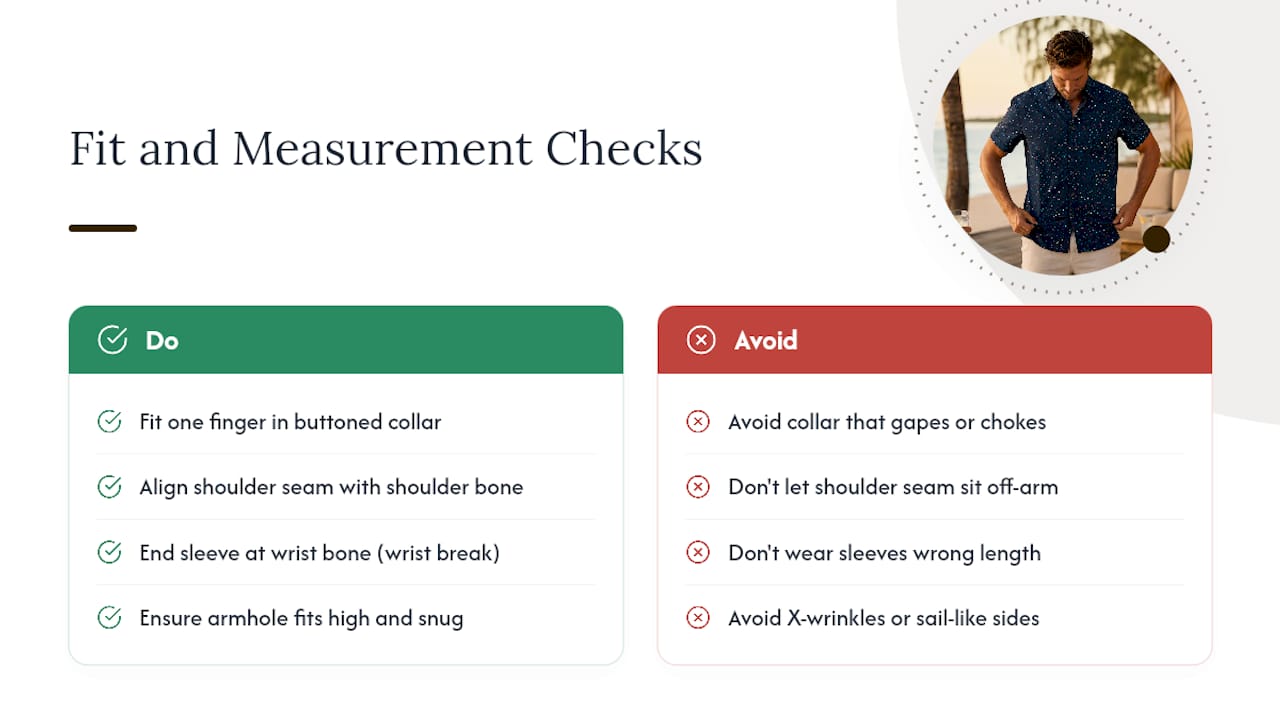
The collar should let you fit roughly one finger between the fabric and your neck when buttoned. Any tighter and it strains at the throat; any looser and it gaps under a jacket or tie. The shoulder seam should sit right at the edge of your shoulder bone, not creeping down your arm or pulling up toward your neck. Sleeve length should end right at your wrist bone, the point tailors call the wrist break, with the cuff covering it just enough to show a sliver of shirt when your arm hangs naturally.
Armhole height matters more than most buyers realize. A higher, tighter armhole reduces fabric drag when you move your arms and keeps the shirt from ballooning under the arm when you reach or lift something. Body taper, meanwhile, should follow your actual shape without pulling. The tell here is the X-wrinkle: diagonal creases radiating from the buttons mean the shirt is too tight through the torso, while loose, sail-like fabric at the sides means it’s cut too generously.
Off-the-rack shirts compromise on one of these measurements almost by design, since a standard size chart can’t fit every torso shape.
A Practical Inspection: 6 Close-Up Checks That Confirm Quality
Whether you’re standing in a fitting room or scrolling product photos online, this order catches the details that matter most before you catch the ones that don’t.
- Seam straightness and stitch count. Look along the side seam for even spacing and a straight line with no wandering.
- Collar roll test. Press it flat, release, and watch whether it springs back or lies limp.
- Pattern alignment. Check the placket, chest pocket, and yoke seam for matched stripes or florals, a detail Gentleman’s Gazette treats as a dependable proxy for careful cutting.
- Button and buttonhole finish. Twist the button, then check the buttonhole edge for clean, dense stitching with no loose threads.
- Interior seam finish. Flip the shirt inside out and confirm seams are flat-felled or overlocked cleanly, not raw and fraying.
- Hem and gusset check. Look at the side hem and underarm gusset for reinforced stitching rather than a single thin seam.
How to Verify Quality Features Before Buying
Treat the checks in this guide as inspection points, not as claims about every shirt. Construction and fabric can vary by product. Before buying, review the exact product description, care label, photos, and size chart. If a feature such as fiber composition, pattern matching, button material, stitch type, or fabric finish is not stated on that product page, do not assume it is included.
For Dan Flashes products, use the details shown on the individual product page. Contact us before ordering if a specific construction feature matters to you.
Common Fabric Types Behind High-Quality Shirts
Fabric names on a tag often carry more marketing weight than substance, but a few genuinely earn their reputation. Egyptian cotton grows in a climate that favors longer fibers, which is why it spins into the long-staple yarn discussed earlier in this guide. Not every shirt labeled “Egyptian cotton” actually uses fiber grown in Egypt, so the label alone isn’t proof of quality; the staple length and ply still matter more than the name.
Sea Island cotton takes that a step further with an even longer, finer fiber grown almost exclusively in a handful of Caribbean locations, producing a smoother, more lustrous cloth than standard long-staple cotton. It’s rare and expensive enough that most everyday shirts won’t use it, and there’s little reason to chase it for casual or warm-weather wear where breathability matters more than sheen.
Pima cotton, grown mainly in the American Southwest and Peru, offers a similar long-staple structure at a more accessible price point, making it a common upgrade fabric in mid-tier shirts. For beach and resort shirts specifically, blended fabrics like cotton with bamboo hemp often outperform pure long-staple cotton on comfort, since the blend adds moisture handling and drape without sacrificing the breathability that matters most in heat. The takeaway: chase staple length and yarn quality over brand names on a tag.
Environmental and Ethical Claims: What to Verify
Terms such as organic, sustainable, lower-impact, and fair-wage should be supported by certification or supply-chain documentation. A fabric name or product photo does not prove those claims. Check the stated fiber composition and care instructions first, then verify any environmental or labor claim separately with the seller.
Shirt Finishes: Mercerization, Sanforization, and What They Actually Change
Two finishing processes show up constantly in fabric descriptions, and both change how a shirt performs without changing the fiber itself. Mercerization treats cotton yarn with a caustic soda solution under tension, which smooths the fiber surface, boosts luster, and improves dye absorption. A mercerized cotton shirt looks slightly glossier and feels smoother than an untreated equivalent, and it also resists shrinking better after the treatment.
Sanforization is a mechanical pre-shrinking process that stretches and relaxes the fabric before it’s cut and sewn, so the finished shirt shrinks minimally, usually under 1%, in future washes. Without this step, a cotton shirt can shrink several percent in its first few washes, throwing off the careful fit measurements covered earlier in this guide. Almost all quality cotton shirting goes through sanforization now, which is why a well-made shirt should hold its measurements wash after wash rather than creeping smaller each time it hits the dryer.
Neither finish shows up as a visible feature you can check with your hands the way stitching or buttons do, but both explain why two shirts made from what looks like the same cotton can behave completely differently after six months of regular washing.
The Trade-Off Nobody Tells You About Quality Shirts
Most guides treat hand-sewn buttonholes and unfused collars as the gold standard, full stop. That’s marketing more than reality. Fabric quality and precise single-needle stitching move the needle on how long a shirt lasts far more than whether a buttonhole was finished by hand, a point Care of Carl’s own construction analysis backs up. Hand-finishing is a craft flourish. Fabric and stitch density are the engineering.
The conventional advice also overweights fused collars as an automatic red flag. A well-made fused collar holds a crisp line that some formal shirts genuinely need, and dismissing it outright ignores what the shirt is actually for. Context beats dogma here.
If you take one thing from this guide, prioritize fabric and fit before you obsess over buttonhole stitch counts. A shirt with mediocre buttons but excellent long-staple cotton and a collar that fits your neck will outperform a shirt with flawless buttonwork sewn onto thin fabric and a collar that gaps. Get the fundamentals right first. The details are worth chasing only after that.
Compare a Product Before Ordering
Start with the exact product page because materials, construction, and measurements can differ by shirt. Review every available image, check the fiber information listed for that item, and compare the size chart with a shirt you already own. If a detail is not shown, ask us before ordering.
Browse all current shirts and compare the product-specific details that matter most to you.
Sources
- What Makes a Quality Dress Shirt: Fabric, Make, and Fit - SARTORO
- How Men’s Dress Shirts Are Made (Quality Hallmarks) - Gentleman’s Gazette
- Behind the seams: How to recognize a high-quality shirt - Care of Carl
- How to buy a quality shirt - Permanent Style
- Single vs Double Needle Tailoring: Londa’s Tips


